Мы поможем в написании ваших работ!
ЗНАЕТЕ ЛИ ВЫ?
|
Except for your tears, the tears of living beings have never fallen on the earth which was ruled by the Kuru kings and well protected by arms of punishment.
Содержание книги
- The calves do not drink milk and the cows do not give milk. The cows wail with tearful faces and the bulls do not enjoy the fields.
- O Arjuna! Are our relatives, the Madhus, Bhojas, Daśārhas, Arhas, Sātvatas, Andhakas and Vṛṣṇīs well in Dvārakā?
- Is Lord Govinda, who is kind to the brāhmaṇas and affectionate to the devotees, happily presiding over the Sudharmā hall surrounded by his friends in the city?
- Were you struck by harsh words without affection? Did you fail to give what you had promised to someone who requested from you and then remained silent?
- Giver of shelter, did you perhaps reject brāhmaṇas, children, cows, elders, invalids and women, and other living beings, who took shelter of you?
- pāṇḍava-svargārohaṇaṁ nāma
- Just as a dead person without life becomes repulsive, the world which is separated from Kṛṣṇa even for a moment appears repulsive.
- O best of kings! Without the lord, my dear friend, companion, my mind being vacant, while protecting his queens on the road, like a weakling, I was defeated by criminal cowherds.
- According to common vision only, the destruction of the Yadus occurred by the will of the Lord, because actually living beings themselves cause their own survival and destruction.
- When I remember the words of Govinda which were suitable to place, time and subject, and which calmed the pain in my heart, those words break my heart.
- When Arjuna contemplated the lotus feet of Kṛṣṇa with deep affection, his intelligence, regaining steadiness, became calm.
- Regarding both burdens equally, the Lord separated himself from that portion of the Yadus by which he removed the burden of the earth, like removing a thorn with another thorn.
- He enthroned Vajra as the king of Śūrasena in Mathurā and then being capable, performing pṛajāpatya sacrifice, placed within himself the fires.
- Giving up all clothing and bracelets, he was free of thoughts of “I” and “mine” and the unlimited bonds of attraction.
- He wore torn cloth, did not eat, stopped speaking, shaved his head, and showed himself as a dumb or insane person or a ghost.
- Vidura also, by absorbing his mind in Kṛṣṇa, gave up his body at Prabhāsa and went to his abode escorted by Pitṛs.
- parīkṣite dharma-pṛthvī-saṁvādo nāma
- He married Iṛāvatī, the daughter of king Uttara, and bore four sons starting with Janamejaya.
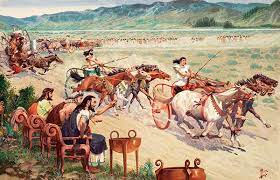
- He had gone out from his city to gather tribute with his troops along with chariots, horses, and elephants on a chariot with lion flag, pulled by black horses and well decorated.
- Conquering Bhadrāśva, Ketumāla, Bhārata, the northern Kuru provinces, and other countries such as Kimpuruṣa, he received taxes.
- Hear from me the most astonishing event that suddenly occurred while he was following this procedure of the previous kings daily.
- O best of the devatās! I lament for myself and you, and for the devatās, Pitṛs, sages, devotees and all the varṇas and āśramas.
- While the earth and dharma were conversing, the king named Parīkṣit came to the Sarasvatī River flowing east.
- atha saptadaśo 'dhyāyaḥ
- Situated in his chariot, with his bow poised, in a voice deep as thunder, he questioned the śūdra dressed in gold.
- Except for your tears, the tears of living beings have never fallen on the earth which was ruled by the Kuru kings and well protected by arms of punishment.
- Son of Surabhī! You have four legs. Who has cut off three of your legs? There should never be such a condition in the state ruled by kings following Kṛṣṇa.
- O best of men! I do not know the person who is the cause of my suffering, since I am bewildered by different statements of scripture.
- Some say the self is the cause of suffering. Others say planets are the cause of suffering. Others say karma is the cause. Others say the inherent property of matter is the cause.
- It is certain that the course of the Lord’s māyā is beyond the thought and words of the living entities.
- Pacifying dharma and earth in this way, Parīkṣit took his sharp sword for killing Kali, the cause of adharma.
- Seeing the king intending to kill him he gave up the markings of a king in great fear and bowed his head to Parīkṣit’s feet.
- When you become situated in devatās and men, all sorts of irreligion follow: greed, untruth, theft, vulgarity, giving up dharma, poverty, deceit, quarrel and pride.
- Directed in this way by Parīkṣit, trembling Kali spoke to Parīkṣit who had his sword raised, appearing like Yama ready to kill him.
- When implored again, the king gave the place where there was gold. In that place there will be untruthfulness, intoxication, illicit sex, pride, and enmity.
- This king, the son of Abhimanyu, who, by protecting the earth, has allowed you to be consecrated for performing sacrifice, had such authority.
- vipra-śāpopalambhanaṁ nāma
- On the day that the Lord left the earth, at that very instant, Kali, the source of irreligion, entered the world.
- Kali was an attentive tiger among inattentive men. But what could powerful Kali do to the innocent people since he was afraid of the devotees?
- One day while taking his bow and hunting in the forest, after pursuing animals he became tired, hungry and very thirsty.
- Not seeing water anywhere, he entered the hermitage of a sage, and saw the peaceful sage sitting with closed eyes.
- In anger he placed a dead snake on the shoulder of the sage using the tip of his bow, left the hermitage and returned to his city.
- This is the sin of kings who are like fat crows! It is a sin committed by servants or door-keepers, who are like dogs, acting against their masters.
- By my order Takṣaka will bite this black sheep of his family, offender of my father, trespasser of boundaries.
- O child! When this king, representative of Viṣṇu, disappears, the people, suffering from thieves, like unprotected sheep, will be destroyed in an instant.
- The Lord, the soul of all beings, should forgive the sin committed to your innocent devotee by this boy of immature intelligence.
- The great sage was sorry for the sin committed by his son, but did not think at all that the king had committed an offense when he (the sage) was treated badly.
- Other exalted sages among the devatās, sages of great penance, sages among kings and Aruṇas also came. Welcoming the best of sages, the king bowed his head.
- Having decided in this way the wise king, entrusting the country to his son, sat down facing north on kuśa grass with tips facing east, on the right bank of the river.
- When the best of the kings sat fasting, the devatās in the sky showered the earth with flowers in praise and continually drums sounded in joy.
TRANSLATION
Except for your tears, the tears of living beings have never fallen on the earth which was ruled by the Kuru kings and well protected by arms of punishment.
COMMENTARY
“You may be a king, but we have become miserable now.” The king then speaks with fiery pride. Except for your tears, tears have not fallen in the land which was well protected (parirambhite) by arms of punishment.
|| 1.17.9 ||
mā saurabheyātra śuco vyetu te vṛṣalād bhayam |
mā rodīr amba bhadraṁ te khalānāṁ mayi śāstari ||
TRANSLATION
O son of Surabhī! Do not lament! Do not fear the śūdra! O mother! Do not weep! Since I am here as the punisher of sinners, you will have good fortune.
COMMENTARY
He then spoke consoling words to the bull who was showing the weeping cow his miserable condition. O son of Surabhi! Do not lament (śucaḥ for śocaḥ). Do not have fear, I will kill him now. He then speaks to the cow. Mayi śāstari means “while I am living as the punisher.”
|| 1.17.10-11 ||
yasya rāṣṭre prajāḥ sarvās trasyante sādhvy asādhubhiḥ |
tasya mattasya naśyanti kīrtir āyur bhago gatiḥ ||
eṣa rājñāṁ paro dharmo hy ārtānām ārti-nigrahaḥ |
ata enaṁ vadhiṣyāmi bhūta-druham asattamam||
TRANSLATION
O cow! The inattentive ruler in whose state all the citizens suffer from criminals loses his fame, lifespan, fortune and progress. This is the highest duty of the kings, to punish those who cause suffering to others. Therefore I will kill that sinful killer.
COMMENTARY
“But if you kill him because of us, then we become implicated in killing. Do not do that.” He replies. “I must kill him for my benefit. It is not because of your request.”
|| 1.17.12 ||
ko ’vṛścat tava pādāṁs trīn saurabheya catuṣ-pada |
mā bhūvaṁs tvādṛśā rāṣṭre rājñāṁ kṛṣṇānuvartinām ||
|