Мы поможем в написании ваших работ!
ЗНАЕТЕ ЛИ ВЫ?
|
pāṇḍava-svargārohaṇaṁ nāma
Содержание книги
- Having learned about Kṛṣṇa, the goal of the jīva, from Maitreya while on pilgrimage, Vidura came to Hastināpura with a desire to teach that.
- Agitated by the longing created by separation, they shed tears of love. The king had him accept a seat and worshipped him.
- As you wandered over the earth, what did you do for maintenance? What major holy places did you serve on the earth?
- As long as Yama passed his life for a hundred years as a śudra because of a curse, Aryamā performed his duties of punishing the sinful in an appropriate way.
- O master! The supremely powerful time which no one can stop has approached us all.
- What is the use of life maintained by food given by those whom you tried to burn, poison, whose wife you insulted, and whose land and wealth you stole?
- Therefore, go to the north, somewhere unknown to your relatives. Then time, destroyer of most of man’s qualities, will come.
- Has he thrown himself in the Gaṅgā along with his wife, out of sorrow, with all his children dead, while contemplating my foolish offense?
- When our father Pāṇḍu departed, these two protected all us children, who were their relatives, from dangers. From this place, where have they gone?
- O king! Do not lament for anything, because this world is dependent on the Lord. The Lord to who even the devatās carry offerings joins and separates the living beings.
- Just as the items used in playing are brought together and separated by the will of the player, humans are brought together and separated by the will of the Lord.
- This body of five elements is dependent on time, karma and the material ingredients. How can a person, as if bitten by a snake, protect others?
- He, the lord of Dvārakā, protector of all beings, has appeared in the form of time to destroy the demons.
- Having completed the actions for the devatās, he is waiting for the remaining activities. While he remains on earth, you should consider all things as objects of attachment.
- Do not be an obstacle to Dhṛtarāṣṭra who has renounced all actions! O king! Five days from now he will give up his body. He will turn himself to ashes.
- While his body is being burned along with the cottage, the noble wife, situated outside, will enter the fire to follow her husband.
- Saying this, Nārada with his vīṇa ascended to Svarga. Yudhiṣṭhira, taking those words in his heart, gave up his lamentation.
- Seeing the men’s sinful qualities filled with greed and the extremely inauspicious symptoms appearing according to time, he spoke to Bhīma.
- From him, by his mercy we have attained wealth, kingdom, wives, life, family, citizens, victory over enemies, and the higher worlds.
- This pigeon, a messenger of death, the owl which is making my mind tremble and the crow desire to empty the universe with their harsh cries.
- The calves do not drink milk and the cows do not give milk. The cows wail with tearful faces and the bulls do not enjoy the fields.
- O Arjuna! Are our relatives, the Madhus, Bhojas, Daśārhas, Arhas, Sātvatas, Andhakas and Vṛṣṇīs well in Dvārakā?
- Is Lord Govinda, who is kind to the brāhmaṇas and affectionate to the devotees, happily presiding over the Sudharmā hall surrounded by his friends in the city?
- Were you struck by harsh words without affection? Did you fail to give what you had promised to someone who requested from you and then remained silent?
- Giver of shelter, did you perhaps reject brāhmaṇas, children, cows, elders, invalids and women, and other living beings, who took shelter of you?
- pāṇḍava-svargārohaṇaṁ nāma
- Just as a dead person without life becomes repulsive, the world which is separated from Kṛṣṇa even for a moment appears repulsive.
- O best of kings! Without the lord, my dear friend, companion, my mind being vacant, while protecting his queens on the road, like a weakling, I was defeated by criminal cowherds.
- According to common vision only, the destruction of the Yadus occurred by the will of the Lord, because actually living beings themselves cause their own survival and destruction.
- When I remember the words of Govinda which were suitable to place, time and subject, and which calmed the pain in my heart, those words break my heart.
- When Arjuna contemplated the lotus feet of Kṛṣṇa with deep affection, his intelligence, regaining steadiness, became calm.
- Regarding both burdens equally, the Lord separated himself from that portion of the Yadus by which he removed the burden of the earth, like removing a thorn with another thorn.
- He enthroned Vajra as the king of Śūrasena in Mathurā and then being capable, performing pṛajāpatya sacrifice, placed within himself the fires.
- Giving up all clothing and bracelets, he was free of thoughts of “I” and “mine” and the unlimited bonds of attraction.
- He wore torn cloth, did not eat, stopped speaking, shaved his head, and showed himself as a dumb or insane person or a ghost.
- Vidura also, by absorbing his mind in Kṛṣṇa, gave up his body at Prabhāsa and went to his abode escorted by Pitṛs.
- parīkṣite dharma-pṛthvī-saṁvādo nāma
- He married Iṛāvatī, the daughter of king Uttara, and bore four sons starting with Janamejaya.
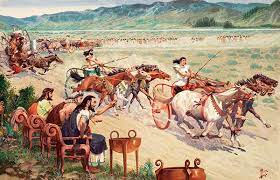
- He had gone out from his city to gather tribute with his troops along with chariots, horses, and elephants on a chariot with lion flag, pulled by black horses and well decorated.
- Conquering Bhadrāśva, Ketumāla, Bhārata, the northern Kuru provinces, and other countries such as Kimpuruṣa, he received taxes.
- Hear from me the most astonishing event that suddenly occurred while he was following this procedure of the previous kings daily.
- O best of the devatās! I lament for myself and you, and for the devatās, Pitṛs, sages, devotees and all the varṇas and āśramas.
- While the earth and dharma were conversing, the king named Parīkṣit came to the Sarasvatī River flowing east.
- atha saptadaśo 'dhyāyaḥ
- Situated in his chariot, with his bow poised, in a voice deep as thunder, he questioned the śūdra dressed in gold.
- Except for your tears, the tears of living beings have never fallen on the earth which was ruled by the Kuru kings and well protected by arms of punishment.
- Son of Surabhī! You have four legs. Who has cut off three of your legs? There should never be such a condition in the state ruled by kings following Kṛṣṇa.
- O best of men! I do not know the person who is the cause of my suffering, since I am bewildered by different statements of scripture.
- Some say the self is the cause of suffering. Others say planets are the cause of suffering. Others say karma is the cause. Others say the inherent property of matter is the cause.
- It is certain that the course of the Lord’s māyā is beyond the thought and words of the living entities.
pāṇḍava-svargārohaṇaṁ nāma
The Pāṇḍavas ascend to the spiritual world
|| 1.15.1 ||
sūta uvāca—
evaṁ kṛṣṇa-sakhaḥ kṛṣṇo bhrātrā rājñā vikalpitaḥ |
nānā-śaṅkāspadaṁ rūpaṁ kṛṣṇa-viśleṣa-karśitaḥ ||
TRANSLATION
Sūta said:
The friend of Kṛṣṇa, Arjuna, was thus questioned by his brother, the king, because he presented himself as an object of worry. He had become thin because of separation from Kṛṣṇa.
COMMENTARY
In the Fifteenth Chapter, hearing the lamentation of Arjuna, and seeing the entrance of Kali, the king enthrones this grandson, and giving up the kingdom, marches to death with his brothers.
Arjuna became the object of doubt (vikalpitaḥ) for the king: was it because of this or was it because of that? The cause was Arjuna’s worrisome condition. He had become thin because of separation from Kṛṣṇa.
|| 1.15.2 ||
śokena śuṣyad-vadana-hṛt-sarojo hata-prabhaḥ |
vibhuṁ tam evānusmaran nāśaknot pratibhāṣitum ||
TRANSLATION
Arjuna, his lotus heart and face dried up because of grief, with dull complexion, remembering the Lord, could not reply.
|| 1.15.3-4 ||
kṛcchreṇa saṁstabhya śucaḥ pāṇināmṛjya netrayoḥ |
parokṣeṇa samunnaddha- praṇayautkaṇṭhya-kātaraḥ ||
sakhyaṁ maitrīṁ sauhṛdaṁ ca sārathyādiṣu saṁsmaran |
nṛpam agrajam ity āha bāṣpa-gadgadayā girā ||
TRANSLATION
Stopping with difficulty the tears and wiping his eyes with his hands, extremely pained by the increased longing of love due to separation, remembering the pure friendship with Kṛṣṇa, friendship mixed with servitude, and friendship mixed with parental feelings towards Kṛṣṇa, he spoke to the king with choked voice filled with tears.
COMMENTARY
Stopping the tears of grief (śucaḥ) in his eyes, he wiped those tears which flowed anyway. Because of Kṛṣṇa not being present (parokṣeṇa), he was in pain. Sakhyam is mutual affection and mutual helping each other. Maitrīm is sakhya mixed with dāsya. Sauhrḍam is sakhya mixed with vātsalya.
|| 1.15.5 ||
arjuna uvāca—
vañcito ’haṁ mahā-rāja hariṇā bandhu-rūpiṇā |
yena me ’pahṛtaṁ tejo deva-vismāpanaṁ mahat ||
|