Заглавная страница Избранные статьи Случайная статья Познавательные статьи Новые добавления Обратная связь FAQ Написать работу КАТЕГОРИИ:  Археология Археология Биология Биология Генетика Генетика География География Информатика Информатика История История Логика Логика Маркетинг Маркетинг Математика Математика Менеджмент Менеджмент Механика Механика Педагогика Педагогика Религия Религия Социология Социология Технологии Технологии Физика Физика Философия Философия Финансы Финансы Химия Химия Экология ЭкологияТОП 10 на сайте Приготовление дезинфицирующих растворов различной концентрацииТехника нижней прямой подачи мяча. Франко-прусская война (причины и последствия) Организация работы процедурного кабинета Смысловое и механическое запоминание, их место и роль в усвоении знаний Коммуникативные барьеры и пути их преодоления Обработка изделий медицинского назначения многократного применения Образцы текста публицистического стиля Четыре типа изменения баланса Задачи с ответами для Всероссийской олимпиады по праву 
Мы поможем в написании ваших работ! ЗНАЕТЕ ЛИ ВЫ?
Влияние общества на человека
Приготовление дезинфицирующих растворов различной концентрации Практические работы по географии для 6 класса Организация работы процедурного кабинета Изменения в неживой природе осенью Уборка процедурного кабинета Сольфеджио. Все правила по сольфеджио Балочные системы. Определение реакций опор и моментов защемления |
After crossing the rivers Dṛṣadvatī and Sarasvatī, He passed through Pañcāla and Matsya and finally came to Indraprastha.Содержание книги
Поиск на нашем сайте TRANSLATION Bhīma should go to him disguised as a brāhmaṇa and beg charity. Thus he will obtain single combat with Jarāsandha, and in Your presence Bhīma will no doubt kill him. COMMENTARY Uddhava said, “Bhīma should beg as charity a one-to-one fight with Jarāsandha.”
Kṛṣṇa objected, “But since they are equal in strength, they are evenly matched and thus neither is likely to win over the other.”
Uddhava replied, “Therefore, if Bhīma fights in Your presence, he will be able to kill Jarāsandha.”
|| 10.71.8 || nimittaṁ param īśasya viśva-sarga-nirodhayoḥ hiraṇyagarbhaḥ śarvaś ca kālasyārūpiṇas tava TRANSLATION Even Lord Brahmā and Lord Śiva act only as Your instruments in cosmic creation and annihilation, which are ultimately done by You, the Supreme Lord, in Your invisible aspect of time.
COMMENTARY Kṛṣṇa said, “But what will be the effect of My merely being present without doing anything?”
Uddhava replied, “Just as time alone creates and destroys the universe with Brahmā and Śiva merely acting as instruments, so You alone will be killing Jarāsandha simply by Your presence, and Bhīma will only be the instrument. Just as You do this for the glorification of Brahmā and Śiva, so You will act only for the purpose of bestowing fame on Bhīma.”
|| 10.71.9 || gāyanti te viśada-karma gṛheṣu devyo rājñāṁ sva-śatru-vadham ātma-vimokṣaṇaṁ ca gopyaś ca kuñjara-pater janakātmajāyāḥ pitroś ca labdha-śaraṇā munayo vayaṁ ca TRANSLATION In their homes, the godly wives of the imprisoned kings sing of Your noble deeds—about how You will kill their husbands’ enemy and deliver them. The gopīs also sing Your glories—how You killed the enemy of the elephant king, Gajendra; the enemy of Sīta, daughter of Janaka; and the enemies of Your own parents as well. So also do the sages who have obtained Your shelter glorify You, as do we ourselves. COMMENTARY Though the devotees have already perfectly sung Your glories in punishing the wicked and protecting the righteous, now, in killing of Jarāsandha Your glories will be even greater. This is expressed in this verse.
Uddhava said, “The wives (devyaḥ:patnyaḥ) of the kings imprisoned by Jarāsandha sing about Your splendid activities in their homes. while taking care of children and performing other domestic chores. What are those activities? They sing about Your future killing of Jarāsandha and freeing of their husbands, having been informed of this by the omniscient sages. When their children cry for their fathers, their mothers tell them, ‘Child, do not cry. Śrī Kṛṣṇa will save your father.”’
Uddhava gives an analogy. “It is just as the gopīs consoled one another by singing about the killing of their enemy Śaṅkhacūḍa and their deliverance from captivity: ‘O friends, be calm. Do not give up your lives by crying endlessly. That same one who saved us from the devouring tiger called Śaṅkhacūḍa, that same ocean of compassion will remember us and save us from the snake bite of time, which has brought the great calamity of separation from Him.’”
“Thus, in the same way You should protect these ladies and reunite them with their husbands by killing Jarāsandha. Then after completing the Rājasūya sacrifice, and while returning here You should secretly go to Vraja and save the gopīs by giving them Your company. Then we and others will sing Your glories.”
Having taken the opportunity, Uddhava gave the advice that was in his mind. Uddhava continued, “Moreover just as the wives and gopīs sing about You, the sages who have surrendered to You, the self-satisfied devotees and we, your dāsya-bhaktas, will also sing Your glories in the course of relishing our own relationships such as servitude. What are these glories? You killed the crocodile enemy of the king of elephants and delivered him. You killed Rāvaṇa, the enemy of Sītā, and Kaṁsa, the enemy of Your parents, and freed Vasudeva and Devakī.”
“O fellow tapasvīs! O friends, O ecstatic devotees! Just as Kṛṣṇa saved Gajendra from the crocodile, Sītā from Rāvaṇa, and Vasudeva and Devakī from Kaṁsa by bestowing His personal darśana and granting them the particular devotional service they hankered for, so He will grant the same to us.”
|| 10.71.10 || jarāsandha-vadhaḥ kṛṣṇa bhūry-arthāyopakalpate prāyaḥ pāka-vipākena tava cābhimataḥ kratuḥ TRANSLATION O Kṛṣṇa, the killing of Jarāsandha, which is certainly a reaction of his past sins, will bring immense benefit. Indeed, it will make possible the sacrificial ceremony You desire.
COMMENTARY Uddhava said, “Killing Jarāsandha will bring great benefits (bhūry-artha), namely protecting the kings; the killing of Śiśupāla and executing the Rājasūya sacrifice, which You desire to perform; and also the accomplishment of the goals which I have hinted at. With the completion of the Rājasūya sacrifice the kings will be saved as a result of their piety (pāka), and Jarāsandha will die as a result (vipākena) of his wickedness.”
The Medinī dictionary says “Pāka refers to ‘a consequence’ or ‘an infant’ and vipāka refers to ‘cooking,’ ‘perspiration,’ or ‘the contrary result of an action.” Uddhava used equivocal words (pāka-vipākena) so that the assembled Yādavas and Kauravas would not understand his intention. If we take the alternate reading of pāpa-vipākena, it means “due to the consequence of the sins of Śiśupāla and others, they would die.” The word prāyaḥ (certainly) is used to express conjecture.
|| 10.71.11 || śrī-śuka uvāca ity uddhava-vaco rājan sarvato-bhadram acyutam devarṣir yadu-vṛddhāś ca kṛṣṇaś ca pratyapūjayan TRANSLATION Śukadeva Gosvāmī said: O King, Devarṣi Nārada, the Yadu elders and Lord Kṛṣṇa all welcomed Uddhava’s proposal, which was entirely auspicious and infallible. COMMENTARY The word acyutam (infallible) indicates that Uddhava’s proposal was “fortified by logical reasoning.” Furthermore, Śukadeva Gosvāmī specifically indicates by the term yadu-vṛddhāḥ that it was the senior members, not the junior ones, who welcomed the proposal. Young princes such as Aniruddha did not like Uddhava’s proposal, since they were eager to fight Jarāsandha’s army immediately.
|| 10.71.12 || athādiśat prayāṇāya bhagavān devakī-sutaḥ bhṛtyān dāruka-jaitrādīn anujñāpya gurūn vibhuḥ TRANSLATION The almighty Personality of Godhead, the son of Devakī, begged His superiors for permission to leave. Then He ordered His servants, headed by Dāruka and Jaitra, to prepare for departure. COMMENTARY Kṛṣṇa took permission from the elders such as Vasudeva, and then ordered His servants to prepare for departure.
|| 10.71.13 || nirgamayyāvarodhān svān sa-sutān sa-paricchadān saṅkarṣaṇam anujñāpya yadu-rājaṁ ca śatru-han sūtopanītaṁ sva-ratham āruhad garuḍa-dhvajam TRANSLATION O slayer of enemies, after He had arranged for the departure of His wives, children and baggage and taken leave of Lord Saṅkarṣaṇa and King Ugrasena, Lord Kṛṣṇa mounted His chariot, which had been brought by His driver. It flew a flag marked with the emblem of Garuḍa. COMMENTARY Kṛṣṇa arranged for His wives (avarodhān) to go along, since they had also been invited to the Rājasūya sacrifice and were eager to attend. Avarodhān means those who reside in the women’s quarters.
|| 10.71.14 || tato ratha-dvipa-bhaṭa-sādi-nāyakaiḥ karālayā parivṛta ātma-senayā mṛdaṅga-bhery-ānaka-śaṅkha-gomukhaiḥ praghoṣa-ghoṣita-kakubho nirakramat TRANSLATION As the vibrations resounding from mṛdaṅgas, bherīs, kettledrums, conchshells and gomukhas filled the sky in all directions, Lord Kṛṣṇa set out on His journey. He was accompanied by the chief officers of His corps of chariots, elephants, infantry and cavalry and surrounded on all sides by His fierce personal guard. COMMENTARY Bhaṭa means infantry soldiers and sādi means cavalry. Together with the leaders of His chariot corps, and surrounded by His own fierce (karālayā:tīvrayā) army, Kṛṣṇa went out of the city wherein all the directions (kakubhā) were filled with musical vibrations of horns and mṛdaṇgas. Kakubhā, a feminine form, is also seen sometimes.
|| 10.71.15 || nṛ-vāji-kāñcana-śibikābhir acyutaṁ sahātmajāḥ patim anu su-vratā yayuḥ varāmbarābharaṇa-vilepana-srajaḥ su-saṁvṛtā nṛbhir asi-carma-pāṇibhiḥ TRANSLATION Lord Acyuta’s faithful wives, along with their children, followed the Lord on golden palanquins carried by powerful men. The queens were adorned with fine clothing, ornaments, fragrant oils and flower garlands, and they were surrounded on all sides by soldiers carrying swords and shields in their hands. COMMENTARY The faithful queens followed their husband in golden palanquins carried by powerful men (nṛvāji).
|| 10.71.16 || naroṣṭra-go-mahiṣa-kharāśvatary-anaḥ kareṇubhiḥ parijana-vāra-yoṣitaḥ sv-alaṅkṛtāḥ kaṭa-kuṭi-kambalāmbarādy-upaskarā yayur adhiyujya sarvataḥ TRANSLATION On all sides proceeded finely adorned women-attendants of the royal household, as well as courtesans. They rode on palanquins and camels, bulls and buffalo, donkeys, mules, bullock carts and elephants. Their conveyances were fully loaded with grass tents, blankets, clothes and other items for the trip. COMMENTARY The term parijana-vāra-yoṣitaḥ, “attendants of the royal household” includes washerwomen and other helpers. The huts were made of usīra grass.
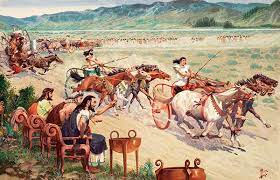
|| 10.71.17 || balaṁ bṛhad-dhvaja-paṭa-chatra-cāmarair varāyudhābharaṇa-kirīṭa-varmabhiḥ divāṁśubhis tumula-ravaṁ babhau raver yathārṇavaḥ kṣubhita-timiṅgilormibhiḥ TRANSLATION The Lord’s army boasted royal umbrellas, cāmara fans and huge flagpoles with waving banners. During the day the sun’s rays reflected brightly from the soldiers’ fine weapons, jewelry, helmets and armor. Thus Lord Kṛṣṇa’s army, noisy with shouts and clatter, appeared like an ocean stirring with agitated waves and timiṅgila fish. COMMENTARY During the day the army shone with the rays of the sun, displaying the splendor of their weapons, jeweled helmets and glittering golden ornaments.
|| 10.71.18 || atho munir yadu-patinā sabhājitaḥ praṇamya taṁ hṛdi vidadhad vihāyasā niśamya tad-vyavasitam āhṛtārhaṇo mukunda-sandaraśana-nirvṛtendriyaḥ TRANSLATION Honored by Śrī Kṛṣṇa, the chief of the Yadus, Nārada Muni bowed down to the Lord. All of Nārada’s senses were satisfied by his meeting with Lord Kṛṣṇa. Thus, having heard the decision of the Lord and having been worshiped by Him, Nārada placed Him firmly within his heart and departed through the sky. COMMENTARY Nārada departed by the path of the sky (vihāyasā). Although the verb is missing, it is understood.
|| 10.71.19 || rāja-dūtam uvācedaṁ bhagavān prīṇayan girā mā bhaiṣṭa dūta bhadraṁ vo ghātayiṣyāmi māgadham TRANSLATION With pleasing words the Lord addressed the messenger sent by the kings: “My dear messenger, I wish all good fortune to you. I shall arrange for the killing of King Magadha. Do not fear.” COMMENTARY Kṛṣṇa said to the messenger, “Do not fear. I will kill Jarāsandha.” The phrase mā bhaiṣṭa, “do not fear,” is in the plural because Kṛṣṇa is addressing both the messenger and the kings.
|| 10.71.20 || ity uktaḥ prasthito dūt yathā-vad avadan nṛpān te ’pi sandarśanaṁ śaureḥ pratyaikṣan yan mumukṣavaḥ TRANSLATION Thus addressed, the messenger departed and accurately relayed the Lord’s message to the kings. Eager for freedom, they then waited expectantly for their meeting with Lord Kṛṣṇa. COMMENTARY The imprisoned kings eagerly waited for Kṛṣṇa to liberate them.
|| 10.71.21 || ānarta-sauvīra-marūṁs tīrtvā vinaśanaṁ hariḥ girīn nadīr atīyāya pura-grāma-vrajākarān TRANSLATION As He traveled through the provinces of Ānarta, Sauvīra, Marudeśa and Vinaśana, Lord Hari crossed rivers and passed mountains, cities, villages, cow pastures and quarries.
COMMENTARY Kṛṣṇa passed through the provinces of ānarta, Sauvīra, Marū and Kurukṣetra (vinaśanaṁ), as He crossed mountains, rivers, cities, villages, pastures and quarries.
|| 10.71.22 || tato dṛṣadvatīṁ tīrtvā mukundo ’tha sarasvatīm pañcālān atha matsyāṁś ca śakra-prastham athāgamat TRANSLATION
|| 10.71.23 || tam upāgatam ākarṇya prīto durdarśanaṁ nṛnām ajāta-śatrur niragāt sopadhyāyaḥ suhṛd-vṛtaḥ
|
||
|
|
Последнее изменение этой страницы: 2024-06-27; просмотров: 74; Нарушение авторского права страницы; Мы поможем в написании вашей работы! infopedia.su Все материалы представленные на сайте исключительно с целью ознакомления читателями и не преследуют коммерческих целей или нарушение авторских прав. Обратная связь - 216.73.217.114 (0.007 с.) |