Мы поможем в написании ваших работ!
ЗНАЕТЕ ЛИ ВЫ?
|
Some brāhmaṇas sitting in that assembly hall would fluently chant Vedic mantras, while others recounted stories of past kings of pious renown.
Содержание книги
- To avenge the death of his friend [Naraka], the ape Dvivida ravaged the land, setting fires that burned cities, villages, mines and cowherd dwellings.
- The mischievous ape climbed a tree branch and then revealed his presence by shaking the trees and making the sound kilakilā.
- Mighty Dvivida also came forward to do battle. Uprooting a śāla tree with one hand, he rushed toward Balarāma and struck Him on the head with the tree trunk.
- Thus fighting the Lord, who again and again demolished the trees He was attacked with, Dvivida kept on uprooting trees from all sides until the forest was left treeless.
- The furious Lord of the Yādavas then threw aside His club and plow and with His bare hands hammered a blow upon Dvivida’s collarbone. The ape collapsed, vomiting blood.
- The angry Kurus said: This ill-behaved boy has offended us, forcibly kidnapping our unmarried daughter against her will.
- Seeing Duryodhana and his companions rushing toward him, Sāmba, the great chariot-fighter, took up his splendid bow and stood alone like a lion.
- But they forced him down from his chariot, and thereupon four of them struck his four horses, one of them struck down his chariot driver, and another broke his bow.
- Upon arriving at Hastināpura, Lord Balarāma remained in a garden outside the city and sent Uddhava ahead to probe King Dhṛtarāṣṭra’s intentions.
- The Kuru nobles said:] Oh, how amazing this is! The force of time is indeed insurmountable: a lowly shoe now wants to climb on the head that bears the royal crown.
- Only because we looked the other way could they enjoy the pair of yak-tail fans and the conchshell, white umbrella, throne, and royal bed.
- How would even Indra dare usurp anything that Bhīṣma, Droṇa, Arjuna or the other Kurus have not given him? It would be like a lamb claiming the lion’s kill.
- Today I shall rid the earth of the Kauravas!” declared the furious Balarāma. Thus He took His plow weapon and rose up as if to set the three worlds ablaze.
- The Lord angrily dug up Hastināpura with the tip of His plow and began to drag it, intending to cast the entire city into the Ganges.
- The Kauravas said:] O Rāma, Rāma, foundation of everything! We know nothing of Your power. Please excuse our offense, for we are ignorant and misguided.
- We bow down to You, O Soul of all beings, O wielder of all potencies, O tireless maker of the universe! Offering You obeisances, we take shelter of You.
- Even today the city of Hastināpura is visibly elevated on its southern side along the Ganges, thus showing the signs of Lord Balarāma’s prowess.
- In one place Lord Gadāgraja was riding on horses, elephants and chariots, and in another place He was resting on His bed while bards recited His glories.
- Somewhere He was consulting with royal ministers like Uddhava, and somewhere else He was enjoying in the water, surrounded by many society girls and other young women.
- O Lord, please give me Your leave. I will wander about the worlds, which are flooded with Your fame, loudly singing about Your pastimes, which purify the universe.
- Having repeatedly seen the vast mystic display of Lord Kṛṣṇa, whose power is unlimited, the sage was amazed and filled with wonder.
- Lord Kṛṣṇa’s Daily Activities
- Lying in her beloved’s arms, Queen Vaidarbhī did not like this most auspicious hour, for it meant she would lose His embrace.
- He would decorate His body, the very ornament of human society, with His own special clothes and jewelry and with divine flower garlands and ointments.
- And there, O King, jesters would entertain the Lord by displaying various comic moods, expert entertainers would perform for Him, and female dancers would dance energetically.
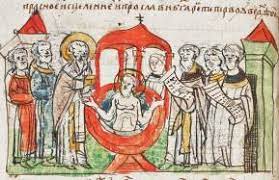
- Some brāhmaṇas sitting in that assembly hall would fluently chant Vedic mantras, while others recounted stories of past kings of pious renown.
- Twenty thousand kings who had refused to submit absolutely to Jarāsandha during his world conquest had been forcibly imprisoned by him in the fortress named Girivraja.
- There is nothing unknown to you within God’s creation. Therefore please tell Us what the Pāṇḍavas intend to do.
- Desiring unrivaled sovereignty, King Yudhiṣṭhira intends to worship You with the greatest fire sacrifice, the Rājasūya. Please bless his endeavor.
- O Lord, exalted demigods and glorious kings, eager to see You, will all come to that best of sacrifices.
- ukadeva Gosvāmī continued:] Thus requested by his master, who, though omniscient, acted as if perplexed, Uddhava took this order upon his head and replied as follows.
- By this decision there will be great gain for us, and You will save the kings. Thus, Govinda, You will be glorified.
- The invincible King Jarāsandha is as strong as ten thousand elephants. Indeed, other powerful warriors cannot defeat him. Only Bhīma is equal to him in strength.
- After crossing the rivers Dṛṣadvatī and Sarasvatī, He passed through Pañcāla and Matsya and finally came to Indraprastha.
- Thus surrounded by His well-wishing relatives and praised on all sides, Lord Kṛṣṇa, the crest jewel of the justly renowned, entered the decorated city.
- With wide-open eyes, the members of the royal household came forward in a flurry to lovingly greet Lord Mukunda, and thus the Lord entered the royal palace.
- Lord Kṛṣṇa bowed down to His aunt and the wives of His elders, O King, and then Draupadī and the Lord’s sister bowed down to Him.
- The Slaying of the Demon Jarāsandha
- The Supreme Personality of Godhead said: Your decision is perfect, O King, and thus your noble fame will spread to all the worlds, O tormentor of your enemies.
- First conquer all kings, bring the earth under your control and collect all the required paraphernalia; then execute this great sacrifice.
- No one in this world, even a demigod—what to speak of an earthly king—can defeat My devotee with his strength, beauty, fame or riches.
- What can the tolerant not bear? What will the wicked not do? What will the generous not give in charity? And who will those of equal vision see as an outsider?
- He indeed is to be censured and pitied who, though able to do so, fails to achieve with his temporary body the lasting fame glorified by great saints.
- Over there is Bhīma, son of Pṛthā, and this is his brother Arjuna. Know Me to be their maternal cousin, Kṛṣṇa, your enemy.
- Having said this, Jarāsandha offered Bhīmasena a huge club, took up another himself and went outside the city.
- As they skillfully circled left and right, like actors dancing on a stage, the fight presented a magnificent spectacle.
- As they thus fought, this contest between opponents of equal training, strength and stamina reached no conclusion. And so they kept on fighting, O King, without any letup.
- Having determined how to kill the enemy, that Lord of infallible vision made a sign to Bhīma by tearing in half a small branch of a tree.
- Lord Kṛṣṇa Blesses the Liberated Kings
- O master, Madhusūdana, we do not blame this King of Magadha, since it is actually by Your mercy that kings fall from their royal position, O almighty Lord.
COMMENTARY
Separate groups of jesters (upamantriṇaḥ), dancers and magicians (naṭācāryāḥ) performed one after the other for Kṛṣṇa’s pleasure in the assembly of great kings.
|| 10.70.20 ||
mṛdaṅga-vīṇā-muraja- veṇu-tāla-dara-svanaiḥ
nanṛtur jagus tuṣṭuvuś ca sūta-māgadha-vandinaḥ
TRANSLATION
These performers would dance and sing to the sounds of mṛdaṅgas, vīṇās, murajas, flutes, cymbals and conchshells, while professional poets, chroniclers and panegyrists would recite the Lord’s glories.
COMMENTARY
Some groups danced and others sang. The professional poets (sūtas) offered praises.
|| 10.70.21 ||
tatrāhur brāhmaṇāḥ kecid āsīnā brahma-vādinaḥ
pūrveṣāṁ puṇya-yaśasāṁ rājñāṁ cākathayan kathāḥ
TRANSLATION
Some brāhmaṇas sitting in that assembly hall would fluently chant Vedic mantras, while others recounted stories of past kings of pious renown.
COMMENTARY
The brāhmaṇas recited (brāhmaṇāḥ āhur) Vedic mantras and those expert at speaking (vādinaḥ) related stories of pious kings.
|| 10.70.22 ||
tatraikaḥ puruṣo rājann āgato ’pūrva-darśanaḥ
vijñāpito bhagavate pratīhāraiḥ praveśitaḥ
TRANSLATION
Once a certain person arrived in the assembly, O King, who had never been seen there before. The doorkeepers announced him to the Lord and then escorted him inside.
|| 10.70.23 ||
sa namaskṛtya kṛṣṇāya pareśāya kṛtāñjaliḥ rājñām
āvedayd duḥkhaṁ jarāsandha-nirodha-jam
TRANSLATION
That person bowed down to kṛṣṇa, the supreme personality of Godhead, and with joined palms he described to the Lord how a number of kings were suffering because Jarāsandha had imprisoned them.
|| 10.70.24 ||
ye ca dig-vijaye tasya sannatiṁ na yayur nṛpāḥ
prasahya ruddhās tenāsann ayute dve girivraje
TRANSLATION
|