Заглавная страница Избранные статьи Случайная статья Познавательные статьи Новые добавления Обратная связь FAQ Написать работу КАТЕГОРИИ:  Археология Археология Биология Биология Генетика Генетика География География Информатика Информатика История История Логика Логика Маркетинг Маркетинг Математика Математика Менеджмент Менеджмент Механика Механика Педагогика Педагогика Религия Религия Социология Социология Технологии Технологии Физика Физика Философия Философия Финансы Финансы Химия Химия Экология ЭкологияТОП 10 на сайте Приготовление дезинфицирующих растворов различной концентрацииТехника нижней прямой подачи мяча. Франко-прусская война (причины и последствия) Организация работы процедурного кабинета Смысловое и механическое запоминание, их место и роль в усвоении знаний Коммуникативные барьеры и пути их преодоления Обработка изделий медицинского назначения многократного применения Образцы текста публицистического стиля Четыре типа изменения баланса Задачи с ответами для Всероссийской олимпиады по праву 
Мы поможем в написании ваших работ! ЗНАЕТЕ ЛИ ВЫ?
Влияние общества на человека
Приготовление дезинфицирующих растворов различной концентрации Практические работы по географии для 6 класса Организация работы процедурного кабинета Изменения в неживой природе осенью Уборка процедурного кабинета Сольфеджио. Все правила по сольфеджио Балочные системы. Определение реакций опор и моментов защемления |
with the Commentary of Medhatithi 239 страницаПоиск на нашем сайте Kātyāyana (Vivādaratnākara, p. 265). — ‘For striking a man with bricks, stones or wooden sticks, the fine is two Māṣas; double of this if blood is fetched; for cutting of the ear, the lip, the nose, the eye, the tongue, the penis or the hand, — the highest amercement; and for piercing these, the middle amercement.’ Hārīta (Vivādaratnākara, p. 266). — ‘If a low-caste man breaks the head, or ears or any limb of a person of the higher castes, he shall be fined 200 Purāṇas; for striking him with the foot, his feet shall be cut off, or he shall he fined 500.’
VERSE 8.285 Section XLII - Assaults
वनस्पतीनां सर्वेषामुपभोगो यथा यथा । vanaspatīnāṃ sarveṣāmupabhogo yathā yathā |
In the case of all trees, as their usefulness so should be the punishment inflicted for injuring them; this is the settled rule. — (285)
Medhātithi’s commentary (manubhāṣya): The ‘trees’ have been mentioned as representing all immovable things. When injury is done to a tree which is of great utility, the fine consists of the ‘highest amercement’; when the tree is of ordinary utility, it consists of the ‘middle amercement’; and when it is of small utility, it consists of the ‘lowest amercement.’ Account has also got to be taken of the part of the tree where the injury is done; — whether it is the leaf, the fruit or the branch that has been cut off. In regard to fruits also, their market-value has to be taken into consideration. Similarly account has to be taken of the position of the tree, — whether it stands on the boundary, on road-crossings or in a hermitage, and so on. — (285)
Explanatory notes by Ganganath Jha: “According to Govindarāja the fine for injuring trees which give shade only is to be very small; in the case of flower-bearing trees, middling; and in the case of fruit trees, high.” — Buhler. This verse is quoted in Vyavahāramayūkha (p. 100); — and in Aparārka (p. 819).
Comparative notes by various authors: Viṣṇu (5.55-59). — ‘A feller of trees yielding fruit shall pay the highest amercement; a feller of flower-bearing trees, only the middle amercement; he who cuts creepers, shrubs or climbing plants shall pay a hundred kārṣāpaṇas; he who cuts grass shall pay one kārṣāpaṇa; and all such offenders shall make good to the owners the revenue which they yield.’ Arthaśāstra (pp. 108-109). — ‘One who destroys small things shall make good their value and also pay a line equal to it; — on destroying large things, he shall make good their value and pay double that amount as fine.’ Yājñavalkya (2.227-229). — ‘For tearing the branches of wide-spreading trees, and of such trees as supply food, the fine shall he 20; for tearing their trunks, 40, and for destroying the entire tree, 80. For such trees as are growing on places of worship, in the cremation-ground, in a sacred place, or in a temple, the fine shall be double. Half of the above-mentioned fine, in the case of destroying thickets, creepers and plants.’ Vaśiṣṭha (Vivādaratnākara, p. 286). — ‘For the purpose of making agricultural implements or implements for the household, one may cut even fruit-bearing and flower-bearing trees and thickets.’
VERSE 8.286 Section XLII - Assaults
मनुष्याणां पशूनां च दुःखाय प्रहृते सति । manuṣyāṇāṃ paśūnāṃ ca duḥkhāya prahṛte sati |
When a hurt has been inflicted on men or animals, with the motive of causing pain, the king shall inflict punishment in proportion to the greatness of the pain caused. — (286)
Medhātithi’s commentary (manubhāṣya): This verse supplies deails (details?) in connection with what has been said before regarding ‘the breaker of skin, etc.’ (in 281). If the term ‘men’ did not occur, and the verse were taken as referring to any and every living creature, it would give the idea that the same punishment is to be inflicted in the case of the larger as well as the smaller beasts, birds and deer; and it is for the. purpose of precluding this idea that the term ‘men’ has been added. ‘In proportion to the greatness of the pain earned’; — if the animal hurt is a large one, and the extent of the bruise or the quantity of blood is small, then the hurt being ‘small,’ the fine shall be less than a hundred; while if the hurt is ‘serious,’ it may exceed a hundred. Others have said that the text has added the term ‘greatness’ for the purpose of indicating that in the case of great pain, the fine shall be increased, — and it does not mean that when the pain caused is not great, the fine shall be decreased. ‘With the motive of earning pain’ — i.e., when the hurt is inflicted with the clear intention of giving pain; hence there is no enhancement of the fine if the hurt has been inflicted by chance carelessness. These two verses are instances of cases where the attendant circumstances have to be taken into consideration in the apportioning of fines for hurt; and it is in this sense that they should be interpreted. — (286)
Explanatory notes by Ganganath Jha: This verse is quoted in Vivādaratnākara (p. 266), which adds that ‘duḥkhāya’ means ‘with the intention of giving pain and the addition of this implies that there is no crime if the hurt is caused by chance; — and in Vivādacintāmaṇi (Calcutta, p. 75), which explains ‘duḥkhāya’ as ‘with the intention of causing pain.’
Comparative notes by various authors: (verses 8.286-287) Viṣṇu (5.75-76). — ‘All those who have hurt a man, shall pay the expense of his cure; — so also those who have hurt a domestic animal.’ Yājñavalkya (2.222). — ‘he who hurts a man should pay the expenses of the cure, and should also be made to pay the fine that has been ordained in connection with lighting.’ Kātyāyana (Aparārka, p. 816). — ‘On hurting the body or the sense-organs, the offender should be fined and also made to pay whatever may satisfy the man hurt, as also the expenses that may be incurred in the complete healing of the wounds inflicted.’ Bṛhaspati (21.10). — ‘He who injures a limb, or divides it, or cuts it off, shall be compelled to pay the expenses of curing it, and he who may have taken away an article during the quarrel shall restore it.’ Arthaśāstra (p. 107). — ‘For breaking the thigh or the neck, for piercing the eye, and for making a man unable to move, or speak or eat, the middle amercement shall he inflicted, and the offender shall also be made to pay the expenses for the healing of the wound.’
VERSE 8.287 Section XLII - Assaults
अङ्गावपीडनायां च व्रणशोणितयोस्तथा । aṅgāvapīḍanāyāṃ ca vraṇaśoṇitayostathā |
In the case of injury to limbs, as also of strength and of blood, — the man should be made to pay the expenses of recovery, or the whole amount as ‘fine.’ — (287)
Medhātithi’s commentary (manubhāṣya): ‘Injury to limbs’ — in the shape of the breaking of joints and the like, caused by the stroke of tough ropes and the like. In such cases the man hurt should receive from the assailant the charges in connection with the physician and the medication incurred in obtaining recovery. A similar construction is to be placed upon the compound word ‘prāṇa-śoṇitayoḥ,’ ‘of strength and blood.’ Or in the case of the latter, the construction may be — ‘prāṇaśoṇitayoḥ samutthānavyayam dāpyaḥ,’ ‘he should be made to pay the expenses for the recovery of strength and blood,’ i.e., ‘when these two have suffered’; this being understood. ‘Prāṇa’ means strength; when a man becomes ill in consequence of the hurt received, he has to go without food, and hence becomes emaciated and loses his strength. In a case where no limb has been seriously injured, the assailant should be made to supply just that quantity of butter and oil and such things as may be needed for the recovery of strength. Similarly when blood has been fetched, and, as a consequence the man becomes weak, or contracts some disease, — the assailant shall be made to pay the expenses incurred in obtaining a complete cure. If the man hurt does not accept all this, then the whole amount is to be totalled up and paid to the king as ‘fine.’ — (287)
Explanatory notes by Ganganath Jha: ‘Prāṇa’ — ‘vital strength’ (Medhātithi); — ‘breathing power’ (Govindarāja and Rāghavānanda). This verse is quoted in Vivādaratnākara (p. 270); — and in Vyavahāra-Bālambhaṭṭī (p. 912).
Comparative notes by various authors: (verses 8.286-287) See Comparative notes for Verse 8.286.
VERSE 8.288 Section XLII - Assaults
द्रव्याणि हिंस्याद् यो यस्य ज्ञानतोऽज्ञानतोऽपि वा । dravyāṇi hiṃsyād yo yasya jñānato'jñānato'pi vā |
When a man, either intentionally or unintentionally, damages the goods of another, he shall give satisfaction to him and pay to the king a fine equal to it. — (288)
Medhātithi’s commentary (manubhāṣya): ‘Goods’ — Household articles, — such as the winnowing basket, the mortar, the jar-platform, the pot and so forth, — or things in connection with which no special punishments have been laid down. The ‘damage’ to these consists in destroying their original shape, even though they still continue to be of use. ‘Intentionally or unintentionally’; — there is no distinction to be made, whether the injury is done by chance, carelessness, or intentionally. He shall ‘give satisfaction’ to the owner of the goods, either by offering to him another article of the same kind, or by paying him the price of the damaged article, or by apologising. And to the king he shall pay the price of that article. To this rule, there are some exceptions’ (and these are noted below). — (288)
Explanatory notes by Ganganath Jha: This verse is quoted in Aparārka (p. 820); — in Vivādaratnākara (p. 352), which adds that each case has to be taken on its merits, in relation to the quality of the property damaged; — in Mitākṣarā (p. 264); — and in Vivādacintāmaṇi (p. 151).
Comparative notes by various authors: (verses 8.288-289) Arthaśāstra (pp. 108-109). — (See under 285, then) — ‘For damaging such things as clothes, ornaments, gold-vessels, the first amercement and also double the value of the article damaged.’ Kātyāyana (Vivādaratnākara, p. 353). — ‘If a man should damage, injure or destroy any articles, he should be made to pay the lowest amercement.’
VERSE 8.289 Section XLII - Assaults
चर्मचार्मिकभाण्डेषु काष्ठलोष्टमयेषु । carmacārmikabhāṇḍeṣu kāṣṭhaloṣṭamayeṣu |
In the case or leather and leathern vessels, and in that of those made of wood or clay, the fine shall be five times their value; as also in the case of flowers, roots and fruits. — (289)
Medhātithi’s commentary (manubhāṣya): Between ‘carma’ and ‘cārmika’ we have the copulative compound, and between the compound thus formed and the term ‘bhāṇḍa’ we have the Determinate Compound. Or, there is Determinate Compound between ‘carma’ and ‘cārmika,’ and Copulative Compound between the compound thus formed and the term ‘bhāṇḍa.’ ‘Leathern’ means made of leather; and ‘leathern vessels’ meant are the leather-bottle and such other articles. ‘Leather’ — stands for the mere skin of the cow and other animals, not made into anything. Or, the term ‘leathern vessel’ may stand for such vessels as are made of leather only, while ‘leathern vessel’ for those that are only bound up with leather. Vessels ‘made of wood’ — the mortar, the pestle, the board and so forth. ‘Clay’ is a form of earth, i.e., earth hardened into the form of stone; and vessels made of these are the cooking utensils, etc. In the case of damage done to these ‘the fine shall be five times their price’; and the satisfaction of the owner has of course got to be brought about. — (289)
Explanatory notes by Ganganath Jha: This verse is quoted in Vivādaratnākara (p. 352), which adds the following notes: — ‘Cārmikam’, ‘shoes and other leather goods,’ — some people explain that in the expressions ‘carmacārmikam’, the first ‘carma’ serves the purpose of making the meaning clearer, — ‘kāṣṭhamayam’, the Prostha and such things, — ‘loṣṭṛamayam’, the jar and such things, — the fine equal to five times the value of the flowers eta is one that has been laid down by Bṛhaspati also, but elsewhere Manu has laid down the fine to be hundred and more times the value of the flower etc., — and these are to be reconciled by the view that the exact fine in each case is to be determined by the quality of the flower etc., damaged; — it has to be noted that the satisfaction of the injured party has to be seemed in these cases also. It is quoted in Aparārka (p. 820).
Comparative notes by various authors: (verses 8.288-289) See Comparative notes for Verse 8.288.
VERSE 8.290 Section XLII - Assaults
यानस्य चैव यातुश्च यानस्वामिन एव च । yānasya caiva yātuśca yānasvāmina eva ca |
In the case of the conveyance, its rider and its owner, they lay down ten exclusions; for the rest penalties are prescribed. — (290)
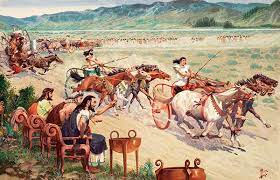
Medhātithi’s commentary (manubhāṣya): The present text proceeds to show that in some oases, even though some damage may be done, it is not regarded as an offence. ‘Conveyance’ — the cart and so forth, riding on which people go on a journey. These carts are drawn by bullocks, mules, buffaloes and such animals. These same animals also, when ridden upon, may be taken as meant by the term ‘Conveyance.’ ‘Rider’ — the driver and other persons riding in the cart. ‘Owner of the conveyance,’ — the person to whom the conveyance belongs. By the force of the running wheels of these carts, or by that of the horse or other animals pulling the cart on the road, some damage or death may be caused; and all such cases would come under the law relating to ‘owner and keeper’ laid down in verse 229 et seq. But in all these, the fault lies sometimes with the rider, sometimes with the owner, sometimes with both, sometimes with no one; and these details not having been dealt with on the previous occasion, they are taken up now. ‘Exclusions’ — i.e., cases where there is no punishment for the injury; and which therefore are not regarded as offences to be penalised. ‘For the rest’; — i.e., for cases other than those just, enumerated, penalties are prescribed; and these are now going to be described. — (290)
Explanatory notes by Ganganath Jha: This verse is quoted in Vivādaratnākara (p. 280), which adds the following notes: — ‘Yāna’, the chariot and the rest, — ‘yantṛ’, the charioteer, — ‘ativartanāni’, ‘lying beyond punishment’, i.e., not to be punished; — and in Vyavahāra-Bālambhaṭṭī (p. 1040).
Comparative notes by various authors: (verses 8.290-294) Yājñavalkya (297-299). — ‘In the cases of injury caused through quadrupeds, or through wood and bricks, or through stones, beasts of burden or conveyances, there is no offence, if the man operating calls out — Move out of the way; — nor does any offence attach to the owner of the conveyance, if the injury caused by it has been due, either to the snapping of the nose-string, or to the breaking of the yoke, or to the cart moving backwards. In the case of tusked and horned animals committing havoc, if the owner, though able to do so, does not check them, he should be made to pay the first amercement; and double of this when the man about to be injured has cried for help.’
VERSE 8.291-292 Section XLII - Assaults
छिन्ननास्ये भग्नयुगे तिर्यक्प्रतिमुखागते । छेदने चैव यन्त्राणां योक्त्ररश्म्योस्तथैव च । chinnanāsye bhagnayuge tiryakpratimukhāgate | chedane caiva yantrāṇāṃ yoktraraśmyostathaiva ca |
When there is snapping of the nose-string, when the yoke is broken, when it turns sideways or backwards, when the axle breaks, and when the wheel is broken; (291) when the fittings or the yoking strap or the bridle are torn, and when there has been the loud cry ‘get out of the way,’ — there is no punishment; so has Manu declared — (292)
Medhātithi’s commentary (manubhāṣya): (verses 8.291-292) The text proceeds to show the cases where there is no offence. ‘Nāsya’ is that which pertains to the nose; the term ending in the affix ‘yat,’ which is added because the basic noun ‘nāsā’ is the name of a limb of the body. It stands for the string that passes through the nostrils of the bullocks, as also for the bridle of the horse, or the goad of the elephant — When this has ‘snapped.’ ‘When the yoke is broken’; — ‘yoke’ is the name of a piece of wood forming part of the cart. The compound ‘chinnanāsyā,’ taken as Bahuvrīhi, refers to the cart or to the animal, both of these being connected with it, either directly or indirectly. ‘When it turns sideways or backwards,’ — i.e., when the cart so turns. When, either on account of the uneven ground, or by reason of the animal having taken fright, the cart turns either sideways or backwards, and some one happens to be hurt, — there lies no offence. The driver can sec and guard against things only in front of him; so that when the cart turns sideways, how can ho sec and avoid striking against anything that may be there? ‘Turning backwards’ means turning round. Others explain this phrase to mean that no offence lies in a case where the injured party has turned sideways, while the cart is going on its straight course; and ‘pratimukha’ they explain as ‘in front.’ The reason for there being no offence in this case is that it is the fault of the injured person himself why he did not make way for the cart coining in front of himself. ‘Axle’ and ‘wheel’ are well known parts of the cart. ‘Fittings’ — the leather thongs with which the wooden parts of the chariot are tied up. ‘Yoking strap’ — the piece of wood on the neck of the animal. ‘Bridle’ — the string with which the movements of the yoked animals are controlled. ‘Loud cry’ — ‘get out of the way’ — i.e., move off. When the animals have gone out of hand, if the driver keeps on crying ‘get out of the way,’ if some one coming by that way happens to be hurt, the fault does not lie with the driver. — (291-292)
Explanatory notes by Ganganath Jha: (verses 8.291-292) These verses are quoted in Aparārka (p. 863); — in Mitākṣarā (p. 299), to the effect that the man is not liable to punishment as the damage is not due to any act of his. Bālambhaṭṭī notes that under the ten circumstances here enunciated, neither the owner nor the driver of the chariot deserves any punishment; — the adjectives ‘chinnanāsye’ etc., refer to the bullocks or other animals yoked to the chariot, — the ‘yuga’ is a piece of wooden pole, — if the piece of wood inside the wheel should happen to be broken on account of the unevenness of the road, — if the ropes with which the several parts of the chariot are bound should be snapped, — similarly on the snapping of the yoking-strap or the reins, — the ‘yoktra’ being the yoking-strap with which the shaft is tied to the back of the bullock, — the tenth circumstance is that when the driver or some one in the chariot has been crying aloud ‘turn aside’; — if under any of these ten circumstances, the chariot should happen to do damage to any living being or to any property, the driver and the rest are not liable to any punishment. It is quoted in Vivādaratnākara (p. 281), which adds the following notes: — ‘Chinnānasye,’ the string connected with the nostrils snapping, — ‘bhinnayuge’, the wooden yoking-shaft breaking, — movement caused by something coming up either sideways on in front, i.e., if by reason of something else coming up sideways, or in front, the chariot should be turned aside and thereby do damage, there is to be no punishment, — ‘akṣa’ is the piece of wood in the wheel (the axle), — ‘yantrāṇām’, the thongs with which the yoking shaft is tied up, — ‘raśmi’, the reins, — if the driver or some one else calls out loudly ‘move off’, and yet disregarding the warning, some one comes too near the chariot and becomes hurt, then the driver and others are not to be punished. It is quoted in Parāśaramādhava (Vyavahāra, p. 290), to the effect that in a case where the hurt is caused by some one who is helpless in the matter, he is not to be punished.
Comparative notes by various authors: (verses 8.290-294) See Comparative notes for Verse 8.290.
VERSE 8.293-294 Section XLII - Assaults
यत्रापवर्तते युग्यं वैगुण्यात् प्राजकस्य तु । प्राजकश्चेद् भवेदाप्तः प्राजको दण्डमर्हति । yatrāpavartate yugyaṃ vaiguṇyāt prājakasya tu | prājakaśced bhavedāptaḥ prājako daṇḍamarhati |
When however, on account of the driver’s ineptitude, the cart turns off and causes injury, the owner shall be punished with a fine of two hundred. — (293) If the driver is a trained one, it is he that should be punished; if the driver is untrained, all the occupants of the cart should be fined a hundred each. — (294)
|
||
|
|
Последнее изменение этой страницы: 2024-07-06; просмотров: 65; Нарушение авторского права страницы; Мы поможем в написании вашей работы! infopedia.su Все материалы представленные на сайте исключительно с целью ознакомления читателями и не преследуют коммерческих целей или нарушение авторских прав. Обратная связь - 216.73.216.60 (0.011 с.) |