Мы поможем в написании ваших работ!
ЗНАЕТЕ ЛИ ВЫ?
|
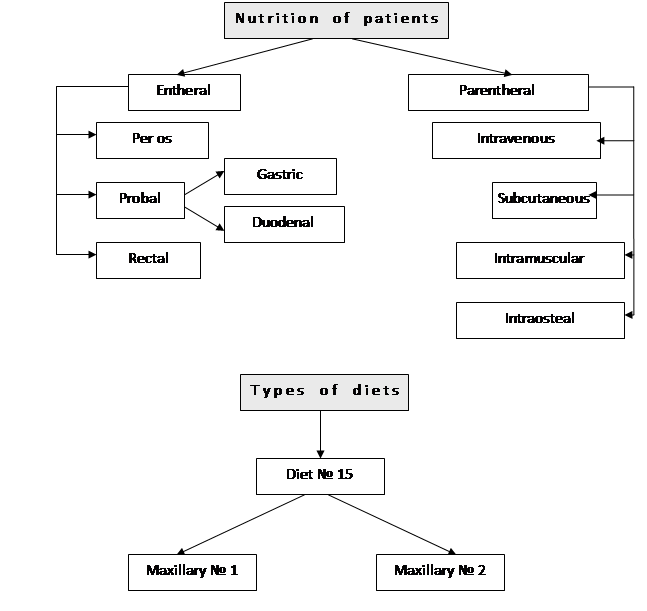
Diet of patients with a maxillofacial trauma
Содержание книги
- Basic therms, parametrs, characterics whith are nessesery during preparation to lesson.
- А. Questions for self - checking :
- А . Questions for self-checking:
- Basic therms, parametrs, characterics whith are nessesery during preparation to lesson.
- А . Questions for self-checking:
- Basic therms, parametrs, characterics whith are nessesery during preparation to lesson.
- А . Questions for self-checking:
- Tasks for individual work during preparation to lesson.
- Injuries to the primary dentition
- Injuries to the alveolar bone
- D. Educational tasks of 3th levels (atypical tasks):
- Tasks for individual work during preparation to lesson.
- Basic knowledge, abilities, skills, which are necessary for study themes ( intradisciplinary integration) .
- Unilateral condylar fractures
- Fractures of the parasymphysis and symphysis
- Signs and symptoms common to Le Fort II and III fractures
- Signs and symptoms peculiar to Le Fort III fractures
- Unilateral Le Fort I, II and Ill-type fractures
- Theme 11. Damage of zygomatic bones and nasal bones in peace-time. Classification, frequency, clinic, diagnostics, treatment. Achievements of native scientists, employees of department.
- Tasks for individual work during preparation to lesson.
- Theme № 13. Seminar. Damages of soft tissues of maxillofacial area and bones of the facial skeleton to a peace time and in extreme conditions.
- Base knowledge, skills, the skills necessary for studying of the theme (interdisciplinary integration).
- Contused wound (Vulnus consutum)
- Characteristics of wound process
- Primary surgical treatment of a wound
- Materials for self-checking:
- Basic therms, parametrs, characterics whith are nessesery during preparation to lesson.
- Basic knowledge, abilities, skills, which are necessary for study themes (intradisciplinary integration)
- Fractures of the tooth-bearing section of the mandible
- Relative indications for removal of a tooth from the fracture line:
- Intermaxillary fixation (IMF)
- Materials for self-checking:
- Theme № 16. osteosynthesis, methods of fixing of fragments of bones of the facial skull. Achievements of native scientists, colleagues of chair.
- Osteosynthesis without intermaxillary fixation
- Non-compression small plates
- Reconstruction of the facial skeleton
- Base knowledge, skills, the skills necessary for studying of the theme (interdisciplinary integration).
- Involvement of the brain and cranial nerves
- Materials for self-checking:
- Base knowledge, skills, the skills necessary for studying of the theme (interdisciplinary integration).
- Organization of trauma services
- Base knowledge, skills, the skills necessary for studying of the theme (interdisciplinary integration).
- Assessment of the depth of burns.
- Tasks for individual work during preparation to lesson.
- Organization of Educational matherial’s content.
- Diet of patients with a maxillofacial trauma
- А . Questions for self-checking:
- Labour prognosis is closely linked to clinical prognosis, and depends on it, although does not always coincide with it.
- Management of temporal disabilities and responsibilities of the attending doctor
- А . Questions for self-checking:
Food reception not less than 4 times a day:
- breakfast – not later than the 9th o'clock in the morning;
- dinner – 13 – 14 hours;
- dinner – 18 hours;
- the second (easy) dinner for 1 – 1,5 hour to a dream.
On caloric content this diet distribute as follows:
- breakfast – 30%;
- dinner – 40%;
- dinner – 20 – 25%;
- the second dinner – 5 – 8%.
Physical methods of treatment of injures of soft tissues of maxillofacial area
| №
| Disease
| Method of treatment
| Duration of procedure
(minutes and biodoses)
| Quantity of procedures
| Interval of procedures
| Notes
| | 1
| 2
| 3
| 4
| 5
| 6
| 7
| | 1.
2.
3.
4.
| Contusion
Hematoma
Wound
Burn
| 1. Diadynamic therapy.
2. Solux.
3. UHF – therapy or
4. Microwave therapy.
5. Paraffin-ozocerite applications.
6. Local UVI.
7. General UVI.
8. Electrophoresis of iodine, ronidase, adrenaline, Novocain, lincomycin.
9. Induct-therapy.
10. Aeroion-therapy.
11. D’arzonvalization.
12. Local cold (bobble-ice).
13. Massage (carefully!).
| 1 – 5
10 – 30
5 – 20
6 – 7
20 – 30
3 – 8
biodoses
3 – 4
biodoses
20 – 30
10 – 20
10 – 15
5
15 – 20
| 3 – 5
10 – 25
8 – 15
5 – 10
8 – 15
3 – 8
10 – 15
10 – 15
10 – 12
15 – 20
5 – 10
3 – 6
3 – 5
| Every day
Every day
Every day
Every day
Every day
On alternate days
Every day
Every day
Every day
Every day
Every day
First 2 – 3 hours
First 2 – 3 hours
|
At burns twice a day.
At hematomas doesn’t use.
At wounds – applications from 2 to 24 hours.
12-16 biodoses, 2–3 procedures treatment of hematomas from 5–6 day.
Iodine-ronidase – at hematomas; Novocain and adrenaline – at burns; lincomycine or chlor thetracycline – at treatment of wounds.
At treatment of hematomes and burns.
At wound treatment.
At flaccid granulations and ample purulent strips of wound.
At hematomas and contuaions.
From 5 – 7 days at treatment of hematomas.
|
Physical methods of treatment at damages of teeth and jaws
| №
| Disease
| Method of treatment
| Duration of procedure
(minutes and biodoses)
| Quantity of procedures
| Interval of procedures
| Notes
| | 1
| 2
| 3
| 4
| 5
| 6
| 7
| | 1.
2.
| Dislocations and fractures of teeth.
Fracturs of jaws.
| 1. UHF – therapy or
2. Microwave therapy.
3. Electrophoresis of iodine, Novocain
4. Aeroion-therapy.
5. Local and general UVI.
6. General hydrochloric-caniferous both.
7. Electrophoresis of calcium and phosphor.
8. Diadynamic therapy.
9. Excersice therapy
10. Paraffin-ozocerite applications.
11. Ultrasound.
12. Solux. (after 10 procedures)
| 10 – 12
5 – 7
15 – 25
6
10 – 15
3 – 4
biodoses
4 – 5
20 – 30
20 – 30
30 – 40
3 – 5
10 – 20
| 4 – 10
6 – 10
4 – 25
7 – 10
15 – 20
20 – 25
20
15
15 – 20
15 – 20
5 – 10
5 – 10
| Every day
Every day
Every day
On alternate days
Every day
On alternate days
Every day
On alternate days
Every day
On alternate days
Every day
On alternate days
Every day
2 – 3 times a day
| After immobilization – 1, 2, 3, 4, 5, 6.
Duration of procedure at fracture of jaw is 6 minutes, cours 7 – 10.
At fractures of jaws.
10 – 12 days after trauma.
After 8.
In case of surplus formation of bone cullus 1 – 4, 8, 10, 12.
| | Note: For treatment of dislocations of mandible on use 1 – 3, 8, 10, 12 procedures + massage of joint’s area 3 – 5 minutes a day.
|
Physical methods of treatment of scurs of face and mucouse membrane of oral cavity
| №
| Disease
| Method of treatment
| Duration of procedure
(minutes and biodoses)
| Quantity of procedures
| Interval of procedures
| Notes
| | 1
| 2
| 3
| 4
| 5
| 6
| 7
| | 1.
2.
| Postsurgical scurs
Celloid scurs
| 1. Paraffin applications.
2. Ultrasound.
3. Electrophoresis of iodine, lydaza, trypsine.
4. Diadynamic therapy of scur.
5. Diadynamic therapy of simpathic nodle.
6. UHF – therapy or
7. Local UVI.
| 30 – 40
5 – 15
20 – 30
10
3
8 – 10
3 – 4
| 10 – 20
10 – 15
20 – 25
5 – 6
5 – 7
7 – 10
10 – 15
| Every day
On alternate days
On alternate days
Every day
On alternate days
Every day
On alternate days
|
At second day after suturing.
| | At scurry contracture of mandible – same procedures (1 – 8) + excersice therapy.
|
6. MATHERIALS FOR SELF-CHECKING:
|
 Археология
 Биология
 Генетика
 География
 Информатика
 История
 Логика
 Маркетинг
 Математика
 Менеджмент
 Механика
 Педагогика
 Религия
 Социология
 Технологии
 Физика
 Философия
 Финансы
 Химия
Химия Экология