Заглавная страница Избранные статьи Случайная статья Познавательные статьи Новые добавления Обратная связь FAQ Написать работу КАТЕГОРИИ:  Археология Археология Биология Биология Генетика Генетика География География Информатика Информатика История История Логика Логика Маркетинг Маркетинг Математика Математика Менеджмент Менеджмент Механика Механика Педагогика Педагогика Религия Религия Социология Социология Технологии Технологии Физика Физика Философия Философия Финансы Финансы Химия Химия Экология ЭкологияТОП 10 на сайте Приготовление дезинфицирующих растворов различной концентрацииТехника нижней прямой подачи мяча. Франко-прусская война (причины и последствия) Организация работы процедурного кабинета Смысловое и механическое запоминание, их место и роль в усвоении знаний Коммуникативные барьеры и пути их преодоления Обработка изделий медицинского назначения многократного применения Образцы текста публицистического стиля Четыре типа изменения баланса Задачи с ответами для Всероссийской олимпиады по праву 
Мы поможем в написании ваших работ! ЗНАЕТЕ ЛИ ВЫ?
Влияние общества на человека
Приготовление дезинфицирующих растворов различной концентрации Практические работы по географии для 6 класса Организация работы процедурного кабинета Изменения в неживой природе осенью Уборка процедурного кабинета Сольфеджио. Все правила по сольфеджио Балочные системы. Определение реакций опор и моментов защемления |
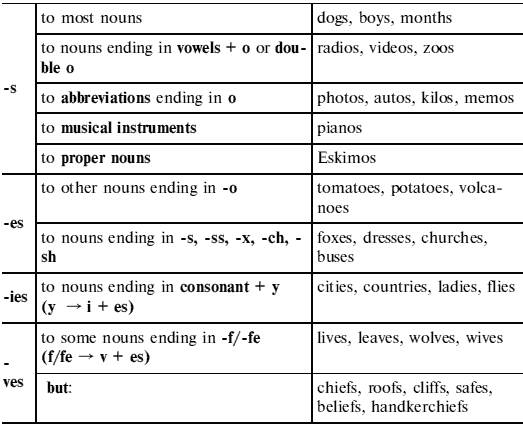
Nouns are made plural by addingСодержание книги
Поиск на нашем сайте
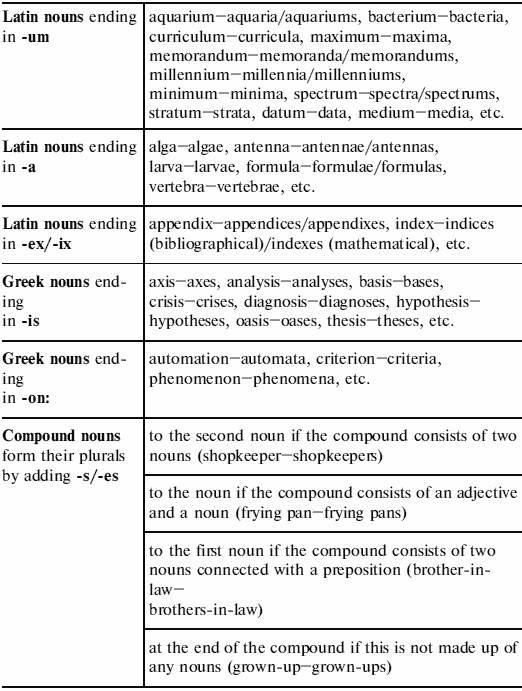
Irregular plurals
Test 1. Write the plural of the following nouns. 1. church – 8. woman – 15. radio — 2. difficulty – 9. deer – 16. ox — 3. mouse – 10. leaf – 17. fish — 4. month – 11. goose – 18. wolf — 5. child – 12. potato – 19. country — 6. roof – 13. foot – 20. tooth — 7. boy – 14. dress – 21. curriculum —
Test 2. Write the plural of the following nouns. 1. nanny – 8. radio – 15. violin — 2. father-in-law – 9. train robbery – 16. wife — 3. headache – 10. painkiller – 17. medium — 4. dictionary – 11. bush – 18. mouse — 5. pincushion – 12. pen-friend – 19. godfather — 6. hold-up – 13. video – 20. wish — 7. hoof – 14. pillowcase – 21. phenomenon —
Test 3. Write the plural of the following nouns. 1. deer – 8. sheep – 15. datum — 2. lady – 9. species – 16. Eskimo — 3. roof – 10. day – 17. leaf — 4. chief – 11. family – 18. life — 5. studio – 12. dish – 19. zero — 6. zoo – 13. paw – 20. buffalo — 7. bus – 14. fork – 21. criterion —
Test 4. Write the plural of the following nouns. 1. trout – 8. baby – 15. vowel — 2. composer – 9. handkerchief – 16. buzz — 3. insect – 10. church – 17. glass — 4. oasis – 11. memo – 18. man — 5. analysis – 12. ball game – 19. goose — 6. bacterium – 13. passer-by – 20. foot — 7. waiter – 14. letdown – 21. volcano —
Test 5. Write the plural of the following nouns. 1. bench – 8. scarf – 15. fruit — 2. celebrity – 9. belief – 16. swine — 3. louse – 10. sheep – 17. activity — 4. bath – 11. half – 18. thief — 5. woman – 12. tomato – 19. kilo — 6. cliff – 13. means – 20. party — 7. play – 14. photo – 21. appendix —
COUNTABLE AND UNCOUNTABLE NOUNS Nouns can be countable (those that can be counted) or uncountable (those that can’t be counted). Uncountable nouns take a singular verb. The most common uncountable nouns are: • Mass nouns: fluids (blood, tea, coffee, milk etc), solids (bread, butter, china, coal, food, fruit, glass, ice, iron, fish [meaning food], etc), gasses (air, oxygen, pollution, smoke, smog, etc), particles (corn, dust, flour, hair, pepper, rice, salt, sand, etc). • Subjects of study: chemistry, economics, literature, mathematics, physics, etc. • Languages: Chinese, English, French, etc. • Games: billiards, chess, golf, soccer, tennis, etc. • Diseases: flu, measles, mumps, etc. • Natural phenomena: darkness, hail, heat, rain (but: the rains = season of continuous rain in tropical countries), humidity, thunder, snow, etc. • Some abstract nouns: accommodation, advice, anger, applause, assistance, behaviour, business, chaos, countryside, courage, damage, dirt, education, evidence, housework, homework, information, intelligence, knowledge, luck, music, news, peace, progress, seaside, shopping, traffic, trouble, truth, wealth, work, etc. • Collective nouns: baggage, cutlery, furniture, jewellery, luggage, machinery, money, rubbish, stationery, etc. • Many uncountable nouns can be made countable by adding a partitive: a piece of paper/cake/advice/information/furniture; a slice/loaf of bread; a(n) item/piece of news, etc. • Some nouns take only a plural verb. These are objects consisting of two parts: garments (pyjamas, trousers, etc), tools (scissors, etc), instruments (binoculars, compasses, spectacles, etc), or nouns such as: arms, ashes, barracks, clothes, congratulations, earnings, (good) looks, outskirts, people, police, premises, riches, stairs, surroundings, wages, etc. • Group nouns refer to a group of people. These nouns can take either a singular or a plural verb depending on whether we see the group as a whole or as individuals. Such group nouns are: army, audience, class, club, committee, company, council, crew, crowd, headquarters, family, jury, government, press, public, staff, team, etc. The team was the best. (the team as a group) The team were all given medals. (each member separately as individuals) • With expressions of duration, distance or money meaning ‘a whole amount’ we use a singular verb: Two years is long to wait. Three miles is a long way to go. Nine thousand pounds is a high price to pay.
Test 6. Fill in: is or are. 1. Your trousers _____ in the wardrobe. 2. Where______ his scissors? 3. There_____ a lecture on history today. 4. The shopping________ heavy. 5. Where_____ my gloves? 6. This information______ correct. 7. His hair_____ brown. 8. My socks_____ in the drawer. 9. Our furniture_____ very cheap. 10. His accommodation_____ luxurious. 11. Evidence_____ needed before the trial can continue. 12. The news_____ very exciting. 13. Mumps_____ a common illness among children. 14. My glasses_____ on the table. 15. Chinese_____ difficult to learn. 16. Where_____ the kitchen scales? 17. Billiards_____ a popular game. 18. His work_____ very interesting. 19. People_____ starving in some countries. 20. Education_____ the key to his success.
Test 7. Fill in: is or are.
1. Where_____ your trousers? 2. Could you tell me where_____ the scissors? 3. Tonight, there _____ athletics on TV. 4. Money_____ easy to spend and difficult to save. 5. Gloves_____ worn in cold weather. 6. This student’s knowledge_____ amazing. 7. Love_____ reason for much happiness. 8. This bread_____ stale. 9. Your jeans_____ on the chair. 10. His baggage_____ too heavy to carry. 11. Her advice _____ very interesting. 12. Mathematics_____ his favourite subject. 13. Measles_____ a common illness. 14. The glasses_____ on the table. 15. My sister’s hair_____ long. 16. Their bathroom scales_____ quite accurate. 17. Darts _____ a popular game in Britain. 18. This work_____ too hard. 19. People_____ unhappy with the new tax system. 20. The police_____ near.
|
||
|
|
Последнее изменение этой страницы: 2016-04-21; просмотров: 990; Нарушение авторского права страницы; Мы поможем в написании вашей работы! infopedia.su Все материалы представленные на сайте исключительно с целью ознакомления читателями и не преследуют коммерческих целей или нарушение авторских прав. Обратная связь - 216.73.217.64 (0.008 с.) |