Заглавная страница Избранные статьи Случайная статья Познавательные статьи Новые добавления Обратная связь FAQ Написать работу КАТЕГОРИИ:  Археология Археология Биология Биология Генетика Генетика География География Информатика Информатика История История Логика Логика Маркетинг Маркетинг Математика Математика Менеджмент Менеджмент Механика Механика Педагогика Педагогика Религия Религия Социология Социология Технологии Технологии Физика Физика Философия Философия Финансы Финансы Химия Химия Экология ЭкологияТОП 10 на сайте Приготовление дезинфицирующих растворов различной концентрацииТехника нижней прямой подачи мяча. Франко-прусская война (причины и последствия) Организация работы процедурного кабинета Смысловое и механическое запоминание, их место и роль в усвоении знаний Коммуникативные барьеры и пути их преодоления Обработка изделий медицинского назначения многократного применения Образцы текста публицистического стиля Четыре типа изменения баланса Задачи с ответами для Всероссийской олимпиады по праву 
Мы поможем в написании ваших работ! ЗНАЕТЕ ЛИ ВЫ?
Влияние общества на человека
Приготовление дезинфицирующих растворов различной концентрации Практические работы по географии для 6 класса Организация работы процедурного кабинета Изменения в неживой природе осенью Уборка процедурного кабинета Сольфеджио. Все правила по сольфеджио Балочные системы. Определение реакций опор и моментов защемления |
Transportation and telecommunications
Belarus, country of eastern Europe. Until it became independent in 1991, Belarus, formerly known as Belorussia or White Russia, was the smallest of the three Slavic republics included in the Soviet Union (the larger two being Russia and Ukraine).
Belarus While Belarusians share a distinct ethnic identity and language, they never previously enjoyed unity and political sovereignty, except during a brief period in 1918. Belarusian history is thus less an isolable national narrative than a study of regional forces, their interplay, and their effects on the Belarusian people. The territory that is now Belarus underwent partition and changed hands repeatedly; as a result, much of the history of Belarus is inseparable from that of its neighbours. Since independence Belarus has retained close ties to its most dominant neighbour, Russia. In 1999 the two countries signed the Union State Foundation Treaty, which aimed to create a politically integrated confederation with a common currency; the precise nature of the partnership, however, remained unclear well into the 21st century. The legacy of Belarus’s Soviet past also continued to manifest itself, both in the persistent prominence of communist political parties and in the country’s authoritarian style of government. About one-fifth of the population of Belarus resides in the centrally located capital, Minsk, a sprawling modern city that was almost entirely rebuilt after its near destruction in World War II.
Land Belarus is a landlocked country bordered by Lithuania and Latvia to the northwest, by Russia to the north and east, by Ukraine to the south, and by Poland to the west. In area, it is roughly one-third the size of its southern neighbour, Ukraine.
Ethnic groups Ethnic Belarusians make up about four-fifths of the country’s population. Russians, many of whom migrated to the Belorussian S.S.R. in the 1960s, ’70s, and ’80s, form the second largest ethnic group, accounting for roughly one-tenth of the population. Most of the remainder are Poles and Ukrainians, with much smaller numbers of Jews, Latvians, Lithuanians, and Tatars. Before World War II (1939–45), Jews constituted the second largest group in the republic (and more than half the urban population); the genocide of European Jewry and postwar emigration nearly eliminated Jews from the republic.
Languages Both Belarusian and Russian are official languages of Belarus. Belarusian, which is central to the concept of national identity, is an East Slavic language that is related to both Russian and Ukrainian, with dialects that are transitional to both. It is written in a Cyrillic alphabet and has loanwords from both Polish and Russian, which is reflective of the region’s history. An older form of Belarusian was the official language of the grand duchy of Lithuania, of which present-day Belarus was an important component.
Trade During much of the Soviet period, the republic was a net exporter, with the bulk of its trade conducted with other Soviet republics, principally Russia and Ukraine. Independent Belarus became a net importer, however, when the price of previously inexpensive raw materials and energy from Soviet sources rose to meet world market levels. Nonetheless, in the early 21st century Russia and Ukraine remained the republic’s main trading partners, with trade increasing with China, Germany, Poland, and other countries of the European Union. Chief exports include refined petroleum, machinery, trucks, tractors, potassium chloride, metals, and foodstuffs. Major imports include crude petroleum, machinery, natural gas, rolled metal, chemical products, and foodstuffs.
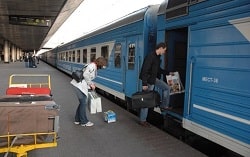
Belarus has a good railway network that is headed by major interregional railways that crisscross the country: east-west between Berlin and Moscow; north-south between St. Petersburg and Kiev (Ukraine); and northwest-southeast between the Baltic countries and Ukraine. The country’s main highway connects the city of Brest in the west to Minsk and the Russian border in the east. There are also good road connections between the capital and all regional centres. Buses operate throughout the country. The city of Minsk is served by an extensive mass transit system that includes buses, streetcars, and an underground railway known as the Minsk Metro. Minsk has good air connections as well. Minsk National Airport, also called Minsk-2, is located about 25 miles (40 km) east of the city; it opened in 1982 and began international service in 1989. A domestic airport for smaller planes, located within the city, serves Belarusian regions and Moscow.
|
||
|
|
Последнее изменение этой страницы: 2024-07-06; просмотров: 67; Нарушение авторского права страницы; Мы поможем в написании вашей работы! infopedia.su Все материалы представленные на сайте исключительно с целью ознакомления читателями и не преследуют коммерческих целей или нарушение авторских прав. Обратная связь - 216.73.216.192 (0.006 с.) |