Заглавная страница Избранные статьи Случайная статья Познавательные статьи Новые добавления Обратная связь FAQ Написать работу КАТЕГОРИИ:  Археология Археология Биология Биология Генетика Генетика География География Информатика Информатика История История Логика Логика Маркетинг Маркетинг Математика Математика Менеджмент Менеджмент Механика Механика Педагогика Педагогика Религия Религия Социология Социология Технологии Технологии Физика Физика Философия Философия Финансы Финансы Химия Химия Экология ЭкологияТОП 10 на сайте Приготовление дезинфицирующих растворов различной концентрацииТехника нижней прямой подачи мяча. Франко-прусская война (причины и последствия) Организация работы процедурного кабинета Смысловое и механическое запоминание, их место и роль в усвоении знаний Коммуникативные барьеры и пути их преодоления Обработка изделий медицинского назначения многократного применения Образцы текста публицистического стиля Четыре типа изменения баланса Задачи с ответами для Всероссийской олимпиады по праву 
Мы поможем в написании ваших работ! ЗНАЕТЕ ЛИ ВЫ?
Влияние общества на человека
Приготовление дезинфицирующих растворов различной концентрации Практические работы по географии для 6 класса Организация работы процедурного кабинета Изменения в неживой природе осенью Уборка процедурного кабинета Сольфеджио. Все правила по сольфеджио Балочные системы. Определение реакций опор и моментов защемления |
The importance of level teaching
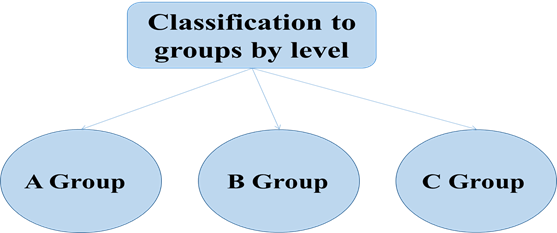
Plan I. Introduction II. Basic part 1. The importance of level teaching 2. Classification to groups by level 3. Feature of the lesson 4. Results of the level teaching III. Сonclusion
Introduction Teachers are aware that the child's interest in learning is declining nowadays. Any teacher can meet this problem everyday. Therefore, in order to awaken the child's eagerness to learn, a teacher needs a lot of work and should work more efficiently. The quality of education depends on the student's passion for knowledge and curiosity. Nowadays, the interstate control in the field of education, the unified national testing, the transition to a 12-year education, is aimed at improving the quality of education in Kazakhstan and bringing it to the international level. These problems are directly related to school chemistry In chemistry, there are a lot of pupils' interest. Interests are the most important conditions for the spiritual and physical development of the human being, and the desire to expand knowledge. The pupil takes the fun lesson with great enthusiasm and reads it well. During the lesson, it is important not to miss the pupils' individual abilities and level of education when using different methods. Difficult creative tasks should only be given to high school students. Delivering high-end tasks to middle-income students gives them a sense of self-assurance and losing interest in learning.
The student's thinking develops well when dealing with one another, and only in interpersonal activities they learn to new concepts, learned to adapt to others, respecting others' ideas, and attitudes. During the lesson one cannot stay out of work and everyone can contribute to the final result of the work. All students in the group is actively involved in making valuable ideas, discussing them and making decisions, because in the teamwork every thought and attitude is valuable. When making any questions, tasks, or experiments, students are encouraged to work in the following order: individual-group.
v During the work with the group each student in the group tries to contribute to the task and identifies students' intellectual abilities. When deciding on such groups, it is important to remember the individual student's ability.
The Characteristics of group students: Ø A group studentsare able to provide intelligent and valuable information than his classmates, who are smart, good in all disciplines. They are students of algorithmic level Ø B group students are well-educated, are not have the personality that is different from others and is not personally identifiable. Their answers is right, but they are mistrustfu Ø C group students are poor readiness for everyday work, desire for knowledge is bad. But they are creativity, critical thinking students
Tasks to A group students include: Ø While performing cognitive - research tasks, students should be able to master new knowledge and innovate themselves, along with improving and deepening the first elementary knowledge acquired on a new subject. Ø Reports solved by different methods Ø Difficult task for thinking
Tasks to B group students include:
Ø Tasks for regulation and systematization of past materials. Ø These are tasks that are altered in the same way as previous tasks, but they must be converted into the first one to apply them. Ø Tasks to improve student thinking.
Tasks to C group students include: Ø Should be adapted to memorization Ø Have to repeat and revise the previous lesson without changing the background of newly knowledge Ø Tasks should be related to the type a new topic
v The objective of division of tasks into a level is to prevent the classroom students from dividing artificially into different strata, "capable" and "incapable" v Performing tasks of the first level fulfills the tasks of the second level v Performing tasks of the second level fulfills the tasks of the third level v Third-level tasks that need to be searched are, of course, talented and hardworking students Trough group work, the teacher achieves the following results: ü Freedom among students ü An atmosphere of trust ü Can evaluate each other ü Students have a personal relationship with each other ü Each student will be able to demonstrate his abilities and peculiarities
Conclusion In old, traditional classes, only a few pupils have been employed, fulfilling the teacher's assignments alone, and each one is responsible only for what he has done. Some of the characters in the closed, hilarious, slower students were dismissed and ignored in the lesson without questioning their questions. And in the classroom approach, all students are involved in group work, as the task must be accomplished through joint work. No matter what a student, he starts his work, even if it is easy for him. All students begin their work simultaneously, and each one reaches their height, depending on their abilities to acquire knowledge. Unless you carry out the tasks of one level with full and correct execution, it will not go to the next level. Upon completing the "compulsory" level, the pupil strives to move forward and self confidence. Each of them is obliged to perform the first-level tasks and have the right to execute high-level tasks. Thus, it improves its ability, gradually supplementing one's level of knowledge to one level. In this case, performing high-level tasks becomes the everyday goal of each student.
Used literatures: 1. Heady, J.E.; Coppola, B.P.; Titterington, L.C. (2001). "3. Assessment Standards". In Siebert, E.D.; McIntosh, W.J. College pathways to the science education standards. NSTA Press. pp. 57–63. ISBN 978-0-87355-193-9. 2. Coppola, B.P. (2007). "The Most Beautiful Theories…". Journal of Chemical Education. 84 (12): 1902–11. Bibcode:2007JChEd..84.1902C. doi:10.1021/ed084p1902. 3. Coppola, B.P.; Jacobs, D. (2002). "Is the Scholarship of Teaching and Learning New to Chemistry?". In Huber, M.T.; Morreale, S. Disciplinary styles in the scholarship of teaching and learning: exploring common ground. American Association for Higher Education. pp. 197–216. ISBN 978-1-56377-052-4. 4. Eddy, Roberta M. (2000). "Chemophobia in the College Classroom: Extent, Sources, and Student Characteristics". Journal of Chemical Education. 77 (4): 514. Bibcode:2000JChEd..77..514E. doi:10.1021/ed077p514. 5. Taber, K.S. (2012). "Recognising quality in reports of chemistry education research and practice". Chemistry Education Research and Practice. 13 (1): 4–7. doi:10.1039/C1RP90058G.
|
||
|
|
Последнее изменение этой страницы: 2024-06-17; просмотров: 57; Нарушение авторского права страницы; Мы поможем в написании вашей работы! infopedia.su Все материалы представленные на сайте исключительно с целью ознакомления читателями и не преследуют коммерческих целей или нарушение авторских прав. Обратная связь - 216.73.216.150 (0.007 с.) |