Заглавная страница Избранные статьи Случайная статья Познавательные статьи Новые добавления Обратная связь FAQ Написать работу КАТЕГОРИИ:  Археология Археология Биология Биология Генетика Генетика География География Информатика Информатика История История Логика Логика Маркетинг Маркетинг Математика Математика Менеджмент Менеджмент Механика Механика Педагогика Педагогика Религия Религия Социология Социология Технологии Технологии Физика Физика Философия Философия Финансы Финансы Химия Химия Экология ЭкологияТОП 10 на сайте Приготовление дезинфицирующих растворов различной концентрацииТехника нижней прямой подачи мяча. Франко-прусская война (причины и последствия) Организация работы процедурного кабинета Смысловое и механическое запоминание, их место и роль в усвоении знаний Коммуникативные барьеры и пути их преодоления Обработка изделий медицинского назначения многократного применения Образцы текста публицистического стиля Четыре типа изменения баланса Задачи с ответами для Всероссийской олимпиады по праву 
Мы поможем в написании ваших работ! ЗНАЕТЕ ЛИ ВЫ?
Влияние общества на человека
Приготовление дезинфицирующих растворов различной концентрации Практические работы по географии для 6 класса Организация работы процедурного кабинета Изменения в неживой природе осенью Уборка процедурного кабинета Сольфеджио. Все правила по сольфеджио Балочные системы. Определение реакций опор и моментов защемления |
Блок 1. You are going to read a text on geography. For questions 1-10, read the text below and decide which answer best fits each gap.Олимпиада для школьников «ЛОМОНОСОВ» Дистанционный тур 10-11 классы Блок 1. You are going to read a text on geography. For questions 1-10, read the text below and decide which answer best fits each gap.
Lake 1. Mead/Superior, America’s largest artificial lake, extends almost 200 kilometres upstream towards the mighty 2. Grand Canyon/Grand Canyon of the Yellowstone. Covering over 600 square kilometres, the deep blue lake is surrounded by stunning desert 3. vistas/villas. Whatever the season, travel in comfort on one of the enclosed sun 4. decks/docks, or feel the wind in your hair and the sun on your face up top on the open promenade deck. A delicious but competitively-priced buffet lunch will be served on board. Enjoy the spectacular sights - the rocky cliffs, the sheltered coves, the flooded gorges - and have an outrageously good time! There will be a full two hours to observe and take pictures of the breathtaking 5. Hoover Dam/Grand Coulee Dam! Towering 220 metres above 6. the Colorado River/Colorado Lake, it is still the 7. Western/Eastern hemisphere's second highest concrete dam, providing domestic water and hydroelectric power for nearby 8. Las Vegas/Los Angeles as well as other major cities in Nevada, 9. Arizona/Virginia and California. On the voyage back we go ashore to take in the fascinating 10. Botanical Gardens/Brooklyn Botanic Garden, where you will have ample time to wander and purchase rare plants and gifts from the well-stocked souvenir shop.
Блок 2. You are going to read an essay on language. Mаtch thе fоllоwing dеfinitiоns with thе wоrds usеd in thе tеxt. Thеrе аrе 15 еxtrа dеfinitiоns thаt dо nоt cоrrеsроnd tо thе mеаning оf thе wоrds in this cоntеxt.
... the decadence of our language is probably curable. Those who deny this would argue, if they produced an argument at all, that language merely reflects existing social conditions, and that we cannot influence its development by any direct tinkering with words and constructions. So far as the general tone or spirit of a language goes, this may be true, but it is not true in detail. Silly words and expressions have often disappeared, not through any evolutionary process but owing to the conscious action of a minority. Two recent examples were explore every avenue and leave no stone unturned, which were killed by the jeers of a few journalists. There is a long list of flyblown metaphors which could similarly be got rid of if enough people would interest themselves in the job; and it should also be possible to laugh the not un- formation out of existence, to reduce the amount of Latin and Greek in the average sentence, to drive out foreign phrases and strayed scientific words, and, in general, to make pretentiousness unfashionable. But all these are minor points. The defence of the English language implies more than this, and perhaps it is best to start by saying what it does not imply. To begin with it has nothing to do with archaism, with the salvaging of obsolete words and turns of speech, or with the setting up of a ‘standard English’ which must never be departed from. On the contrary, it is especially concerned with the scrapping of every word or idiom which has outworn its usefulness. It has nothing to do with correct grammar and syntax, which are of no importance so long as one makes one's meaning clear, or with the avoidance of Americanisms, or with having what is called a ‘good prose style’. On the other hand, it is not concerned with fake simplicity and the attempt to make written English colloquial. Nor does it even imply in every case preferring the Saxon word to the Latin one, though it does imply using the fewest and shortest words that will cover one's meaning. What is above all needed is to let the meaning choose the word, and not the other way around. In prose, the worst thing one can do with words is surrender to them. When you think of a concrete object, you think wordlessly, and then, if you want to describe the thing you have been visualising you probably hunt about until you find the exact words that seem to fit it. When you think of something abstract you are more inclined to use words from the start, and unless you make a conscious effort to prevent it, the existing dialect will come rushing in and do the job for you, at the expense of blurring or even changing your meaning. Probably it is better to put off using words as long as possible and get one's meaning as clear as one can through pictures and sensations. Afterward one can choose — not simply accept — the phrases that will best cover the meaning, and then switch round and decide what impressions one's words are likely to make on another person. This last effort of the mind cuts out all stale or mixed images, all prefabricated phrases, needless repetitions, and humbug and vagueness generally. But one can often be in doubt about the effect of a word or a phrase, and one needs rules that one can rely on when instinct fails. blur · a change in nature, condition · accent concrete · act of changing, improving · an essential element or thesis in an argument dialect · any of the extremities · contaminated fake · deceptive · disreputable flyblown · distinctive form or style · fraudulent humbug · hackneyed · isolated, infrequent hunt · lost · make unclear jeer · mettle · persecute point · seek · smear scrap · solid · something devoid of meaning spirit · something that tricks · specific stale · taunt · the prevailing element strayed · the sum total of an individual's characteristics of speech · to discard as useless tinkering · to quarrel or fight · tout turn · travelling · unpleasant
jeer = taunt tinkering = act of changing, improving flyblown = disreputable strayed = isolated, infrequent point = an essential element or thesis in an argument turn = distinctive form or style scrap = to discard as useless fake = deceptive concrete = specific hunt = seek dialect = the sum total of an individual's characteristics of speech blur = make unclear stale = hackneyed humbug = something devoid of meaning spirit = the prevailing element
Блок 3. You are going to read a text on art. Choose a word from the list to complete each gap (1-20). Change its form where necessary to make a word/a group of words that fits in the gap. Use each word only once.Different aspects of form change are possible: active or passive voice; indicative, imperative or subjunctive mood; finite or non-finite forms (infinitive, gerund, participle); tense for finite forms or aspect for non-finite forms; full or bare infinitive, etc. associate
be
contemplate do
explain express give intend involve kneel long make paint place praise relinquish stand take treat watch
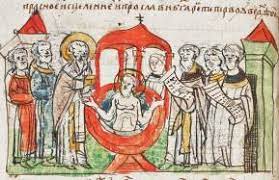
The painting is known as The Entombment and it’s the moment after the Deposition, when Christ 1. has been taken down from the Cross and he’s going 2. to be placed in the tomb. It’s of course a period of huge grief for the people 3. watching, but it’s also a moment of activity. 4. Having stood under the Cross and waited for his death there’s now this moment of activity, they have actually something sensible, something useful to do. The intention of the painting is evidently for us 5. to be involved in this terrible moment because we’re almost pulled into the centre, we’re drawn into the centre of the image, into focus with Christ’s body. And we 6. are made very aware of this terrible moment of pathos where the death that was so dreaded has occurred. This painting’s unusual because it’s unfinished. And although, to some extent, it’s sad when a painting’s not finished because you feel you have only part of the artist’s vision and you 7. long of course to see quite what he 8. would have done, at the same time it’s exciting to see an unfinished image by an artist as enormously important as Michelangelo. So we have a real sense of how he moved around the canvas, how he drew the image on, which sort of colours and which sort of sections he 9. would have painted first. 10. Given that the Entombment concerns a seminal event in Christian tradition, it may be surprising to some that there is so much uncertainty about the identities, and even the gender, of some of the characters in the painting. It appears that the woman in the lower left of the painting, as the viewer sees it, is probably one of the Marys, 11. contemplating something in her unfinished right hand. The massively-built bearer on the left is probably St John the Evangelist, characterised by his orange-reddish robe and long hair. The older man at the back is possibly Joseph of Arimathaea, who 12. had relinquished his own tomb to Christ. The woman on the far right may be Mary Salome, or one of the other Marys. Ironically, the identity of the figure 13. intended for the blank space on the lower right – the most unfinished part of the painting – is among the least contentious, as it is universally accepted as a 14. kneeling Virgin Mary. For posterity Michelangelo has always remained one of the small group of the most exalted artists, who have been felt 15. to express, like Shakespeare or Beethoven, the tragic experience of humanity with the greatest depth and universal scope. In contrast to the great fame of the artist's works, their visual influence on later art is relatively limited. This cannot 16. be explained by hesitation to imitate an art simply because it appeared so great, for artists such as Raphael were considered equally great but were used as sources to a much greater degree. It may be instead that the particular type of expression 17. associated with Michelangelo, of an almost cosmic grandeur, was inhibiting. The limited influence of his work includes a few cases of almost total dependence, the most talented artist who worked in this way 18. being Daniele da Volterra. Otherwise, Michelangelo 19. was treated as a model for specific limited aspects of his work. In the 17th century, he was regarded as supreme in anatomical drawing but less 20. praised for broader elements of his art.
Блок 4.
You are going to read an extract from a conversation between two people.
T:They left—when? K:Yesterday, between ten and eleven. T:And you let them? K:There were ten of them...
M:Of course I’m a mermaid! You can see I’m a mermaid. It’s most impolite to stare like that. P:I’m terribly sorry. I didn’t mean to be rude. Only I’ve never seen a mermaid before. M:(weeping) Well, now you have. P:Oh, dear! I didn’t mean to upset you. Commenton the following aspects of the conversation.
1. What is the subject of the conversation? 2. What was the beginning of the conversation? Think of one sentence that started the conversation. 3. Who are the people having the conversation? Explain why you think they are related in this way. Provide at least two reasons. 4. Where does the conversation take place? Explain why.Provide at least one reason. 5. When does the conversation take place? Explain why.Provide at least one reason. 6. How is each interlocutor feeling throughout the conversation? Provide at least one reasonfor each interlocutor. 7. What might be the end of the conversation? Think of two sentences that the conversation might end in.
Ваш комментарий должен - продемонстрировать умение проанализировать и понять ситуацию общения, воссоздать контекст общения - содержать логичные связки и структурные элементы связного текста - быть оформлен как целостный текст - быть написан в нейтральном и академическом стиле (кроме воссозданных реплик, которые необходимо оформить в соответствии с ситуацией общения) - быть написан в пределах 150-180 слов - продемонстрировать достаточный для полного раскрытия темы уровень лексики - соответствовать нормам грамматики английского языка - соответствовать нормам сочетаемости английского языка
Ваш комментарий не должен - содержать заимствования из ранее опубликованных источников, включая ресурсы, размещенные в сети Интернет (в случае обнаружения заимствований работа снимается с конкурса) - содержать повторы, тавтологичные фразы
|
||
|
|
Последнее изменение этой страницы: 2024-06-17; просмотров: 76; Нарушение авторского права страницы; Мы поможем в написании вашей работы! infopedia.su Все материалы представленные на сайте исключительно с целью ознакомления читателями и не преследуют коммерческих целей или нарушение авторских прав. Обратная связь - 216.73.217.114 (0.006 с.) |