Use the abbreviations key to read the information sent to the ambulance paramedics in Listening
| AMBO
| ambulance
| | AMI
| acute myocardial infarction (heart attack)
| | ATA
| actual time of arrival
| | BHT
| blunt head trauma
| | С
| critical
| | Cat
| category
| | CPR
| cardiopulmonary resuscitation
| | CVA
| cerebrovascular accident (stroke)
| | DoA
| dead on arrival
| | Dx
| diagnosis
| | ETA
| estimated time of arrival
| | Fx
| fracture
| | ICU
| Intensive Care Unit
| | N/A
| not appropriate
| | pos
| possible
| | pt
| patient
| | RTA
| Road Traffic Accident
| | SHO
| Senior House Officer
| | S/N
| Staff Nurse
| | UNK
| unknown
|
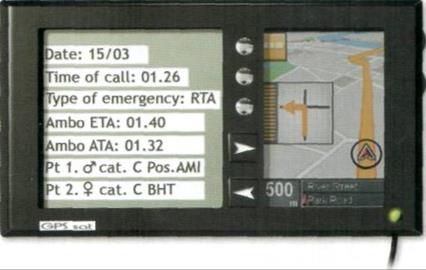
Complete this written version using full words:
The ambulance was called out on the fifteenth of March at to a serious after someone had made an emergency call. A tanker carrying petrol had crashed into the wall of a shop. The ambulance’s was 1.40 a.m. but its was earlier.
There were two casualties. was a male. He was not moving and possibly suffering an . He was categorized . was a female. Blood from her head indicated that she was suffering a .
A pulse oximeter is a probe attached to a patient's finger or ear lobe and linked to a small computer. It displays the percentage of oxygen in the patient's haemoglobin, gives a beep for each pulse beat, and calculates heart rate. In what situation(s) would a pulse oximeter be unreliable?
TESTS
Triage assessment
Complete the description of triage categories with the words and phrases below.
a. grave
b. satisfactory
c. immediately threatened
d. seriously impaired
e. inappropriate
f. stable
g. life-threatening
h. worsening
Critical (cannot wait)
Patient is dying or in a condition.
A very situation that requires top priority.
Urgent (see within thirty minutes)
Acute disorders, but patient is in a condition at the moment.
Requires attention soon or risks bodyfunctions and parts.
Semi-urgent (see within one hour)
Suffering from minor illnesses, but life is not .
Will need to re-triage later in case of condition.
Non-urgent (discharge)
condition which does not present cause for concern. attendance in emergency department.
Use the triage categories in 1 to classify these patients who are all in A&E at the same time.
1. Male found lying face-up on the pavement. Not able to speak. No bleeding. Vomited in ambulance several times. Deeply unconscious.
2. Woman (30s) 'splitting' headache after party the previous day.
3. Boy (15), arm very twisted and out of shape. No pain, but numbness.
4. Woman (20s) has taken ten paracetamol. Very depressed and tearful.
5. Man (20s) black eye after a fight, alcohol intoxication.
6. Child requiring inoculation.
7. Female (50s) overweight, drove to hospital, severe pains in chest that come and go, breathlessness, back pain.
8. Elderly woman (90s) chief complaint: constipation - abdominal pains for several hours.
A triage nurse usually assigns each patient with a chief complaint rather than a diagnosis.
Which of the following is a chief complaint?
- loss of consciousness
- overdose
- stable condition
Speaking
Triage dilemmas
|